Shapeoko 3 XXL · Volume 1
Overview — What the Shapeoko 3 XXL Is, and Where It Fits
1.1 A big, honest cutting machine
The Carbide 3D Shapeoko 3 XXL is a hobby and prosumer CNC router: a computer-controlled machine that drags a spinning cutter through wood, plastic, and — with patience — aluminium, following a path a computer worked out in advance. It is the largest member of the Shapeoko 3 family, and its defining feature is stated right in the name. Where the standard Shapeoko 3 offers a cutting area of roughly 16 by 16 inches, and the XL stretches that to about 16 by 33 inches, the XXL opens the bed all the way to a full 33 by 33 inches (roughly 838 by 838 millimetres) in the horizontal plane, with about 3 inches (76 millimetres) of vertical travel in stock form. That is a genuinely large working envelope for a machine that lives on a bench rather than a factory floor.
That envelope is the whole point. A maker who buys the XXL rather than one of its smaller siblings is almost always buying it for size: to cut a full guitar body, a cabinet door, a large sign, a nesting sheet of small parts all in one setup, or a jig longer than any other tool in the shop can hold. The trade-off for that size is discussed honestly throughout these volumes, because the XXL is an open-frame, belt-driven machine, and both of those words carry consequences. But before the caveats, it is worth being clear about what the machine actually is and why it has been one of the most popular desktop CNC routers of its generation.
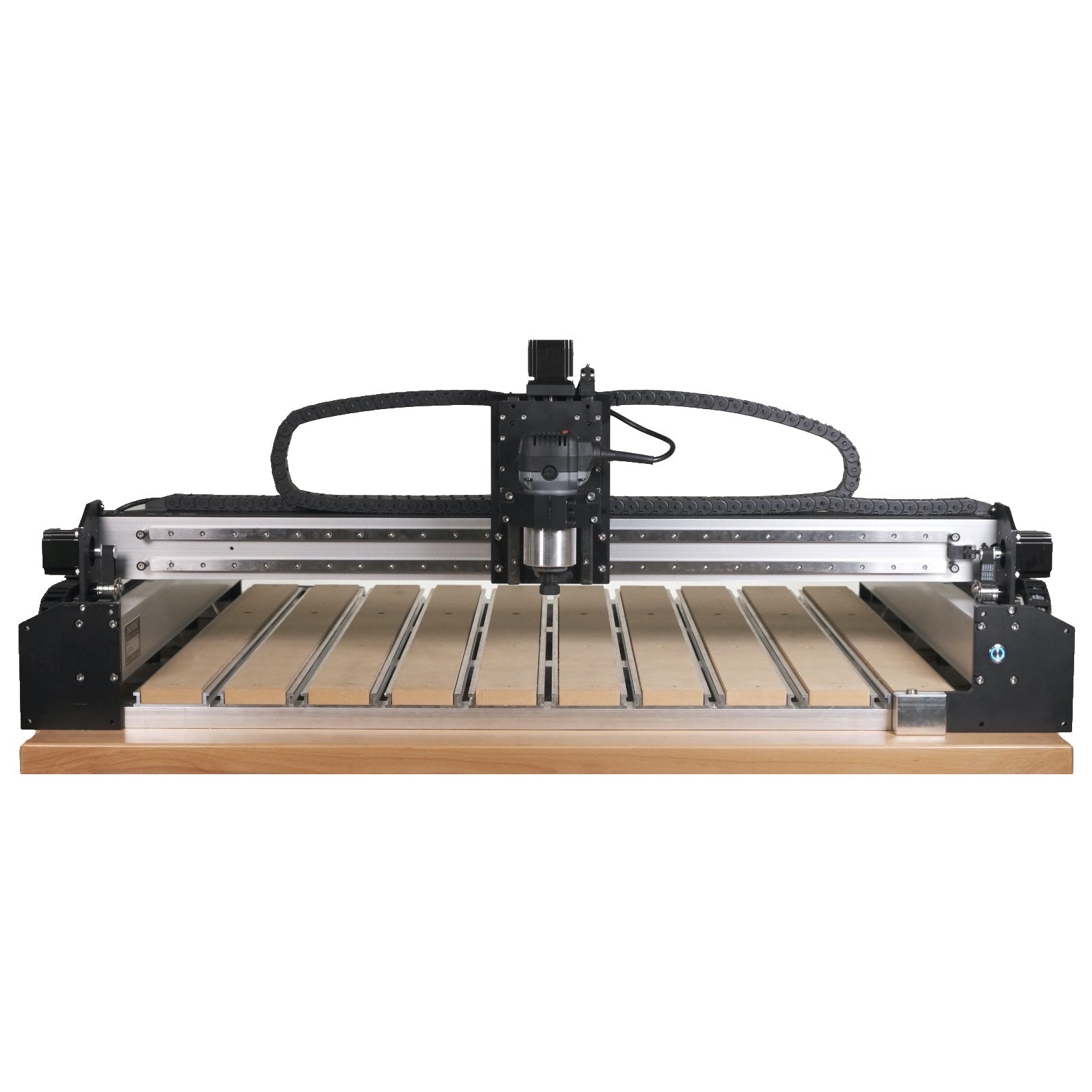
The machine documented here is not a stock XXL. It has been heavily modified: it lives inside a custom-built cabinet, its stock belt-driven Z axis has been replaced with a lead-screw-driven Z, and it is run from a dedicated PC using CNCjs rather than the stock Carbide Motion software. Those three modifications get a volume of their own, and — because the specifics of the owner’s build are still being documented — that volume covers the general engineering of each upgrade accurately while leaving clearly-marked slots for the owner’s own parts, photos, and configuration. Everything else in these volumes describes the base machine from public information, so that the modifications make sense against the backdrop of what they changed.
1.2 The CNC-router category, briefly
It helps to place the Shapeoko in the wider landscape of computer-controlled cutting machines, because “CNC” covers everything from a desktop engraver to a machine the size of a shipping container.
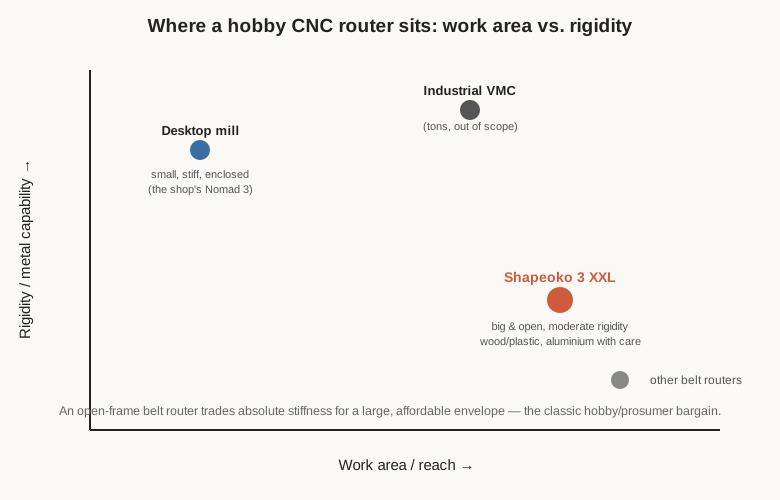
A CNC router is, at heart, a woodworking router — a high-speed spinning motor with a cutting bit in a collet — mounted on a machine that moves it around in three axes under computer control. The word router signals the family it comes from: routers spin fast (tens of thousands of RPM) and take small bites, which suits wood, plastics, foam, composites, and soft metals. This is distinct from a CNC mill, which spins more slowly, pushes far harder, and is built stiff and heavy to remove metal. The shop’s Nomad 3 sits closer to the mill end of that spectrum: small, rigid, enclosed, and comfortable in metal. The Shapeoko sits at the router end: large, lighter, open, and happiest in wood and plastic. Neither is “better”; they are tools for different jobs, and a shop that owns both rarely regrets it.
Within CNC routers, there is a further split between open-frame and closed-frame designs. An industrial router has a massive welded steel or cast base, linear rails the size of a forearm, and a gantry that barely flexes under load. A hobby router like the Shapeoko builds its frame from aluminium extrusion — the same kind of slotted structural profile used for machine guards and framing — bolted into a rectangle, with the cutter carried on a gantry that rolls along that frame. It is lighter, cheaper, and easier to ship as a kit, at the cost of absolute rigidity. The Shapeoko was one of the machines that proved this formula could be good enough for serious hobby and small-shop work, and the XXL proved it could be done at a large scale without the price climbing into industrial territory.
1.3 The Shapeoko lineage
The Shapeoko name predates Carbide 3D’s ownership of it. The original Shapeoko was an open-source desktop CNC project — Edward Ford’s design, sold in early form through the maker-tools world of the early 2010s — built around MakerSlide aluminium extrusion and driven by belts and stepper motors. It was deliberately cheap, deliberately hackable, and deliberately simple, and it built a community that documented and modified it exhaustively. Much of that community knowledge still circulates today and is one of the reasons the platform remains easy to own and modify.
Carbide 3D took the design forward and, with the Shapeoko 3, turned it from a fiddly open-source kit into a machine that a reasonably careful person could assemble in an afternoon and expect to work. The Shapeoko 3 kept the founding ideas — extrusion frame, belt drive, stepper motors, open frame — but stiffened everything up: heavier extrusions, thicker steel motion plates, larger stepper motors, and a proper controller board and software stack. Crucially, Carbide sold it in three sizes built from the same parts: the standard, the XL, and the XXL. All three share the same gantry, the same electronics, the same Z axis, and the same router mount. The only real difference is how long the side rails are and how big the bed is.
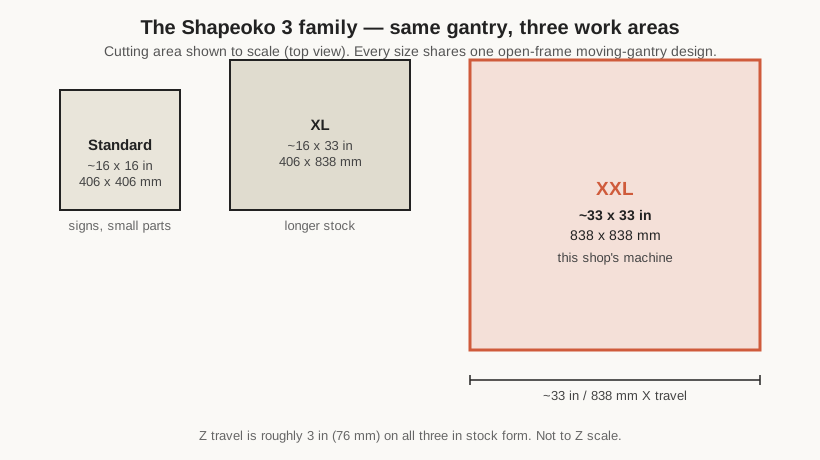
Because the three sizes are mechanically identical apart from length, everything true of a Shapeoko 3’s motion system, controller, and software is true of the XXL as well — a useful fact, because it means the deep well of community documentation written for “the Shapeoko 3” applies directly. The XXL simply has more rail for the gantry to travel along, which brings its own realities: a longer belt has more stretch in it, a longer gantry beam has more room to flex, and a bigger bed is harder to keep flat and square. Those are the specific challenges the large format brings, and they inform several of the modifications this machine has received.
Later Carbide machines — the Shapeoko 4, the Shapeoko Pro, and the current Shapeoko 5 Pro — evolved the design further, adding stiffer hybrid extrusions with embedded steel rails, belt tensioners, and lead-screw Z axes as standard equipment. Many of those factory improvements are, in spirit, exactly the upgrades that Shapeoko 3 owners had been making by hand for years. The machine documented here is a Shapeoko 3 XXL that has been brought partway along that same evolutionary path by its owner, most notably in its Z axis.
1.4 What the XXL is made of
A quick tour of the anatomy, saved in full detail for the next volume, sets up everything that follows.
The frame is aluminium extrusion, bolted into a large rectangle and sitting on adjustable feet. Two long extrusions form the left and right rails; the cutter is carried on a gantry — a beam that spans the machine side to side and rolls forward and back along those rails. This is the classic moving-gantry layout, and it means the whole gantry, motor and all, travels in one axis while the cutter travels along the beam in another.
Motion in all three axes rides on V-wheels: hard polymer wheels with a V-shaped groove that run along the machined edges of the extrusion, held in preload by eccentric adjusters. There are no ground linear rails in the stock machine; the extrusion itself is the rail. The X and Y axes are driven by GT2 toothed belts, 9 millimetres wide, pulled by pinions on the stepper motors. The stock Z axis is also belt-driven, using a narrower belt — and it is precisely this stock belt Z that the owner has replaced.
The motors are NEMA 23 stepper motors — bipolar steppers that rotate in fixed 1.8-degree steps, 200 steps per revolution, giving the controller precise open-loop positioning. They are driven by a Carbide Motion controller board running GRBL, the open-source motion-control firmware that has become the lingua franca of hobby CNC. GRBL takes G-code (the numerical control language that describes toolpaths) and turns it into carefully timed step-and-direction pulses for the motors.
The cutter is a trim router. Carbide sells its own Carbide Compact Router (variable speed, roughly 12,000 to 30,000 RPM); many owners fit a DeWalt DWP611, a popular compact router that runs from about 16,000 to 27,000 RPM. Either clamps into a 65-millimetre mount on the Z carriage and takes standard 1/4-inch and 1/8-inch collets.
Finally, the workpiece is held on a wasteboard — a sheet of MDF sitting on the frame, into which clamps, hold-downs and the inevitable stray cut can bite without damaging the machine. On the XXL this is a large expanse, usually with threaded inserts or T-slot tracks for clamping.
1.5 What it is good at
The honest answer to “what can it cut?” is: quite a lot, provided the maker respects what a light, belt-driven, open-frame machine is and is not.
In wood — hardwood, plywood, MDF — the XXL is entirely at home. Signs, carved panels, furniture parts, cabinet doors, templates, and jigs are its bread and butter, and the large bed is a real advantage: a design that would need tiling or re-fixturing on a smaller machine fits in one setup. V-carving lettering and relief work, where the machine traces intricate paths but removes little material at a time, plays perfectly to its strengths.
In plastics — HDPE, acrylic, phenolic, machinable foams — it is likewise strong, with the usual caveat that plastics melt if the cutter dwells and the chips are not cleared, so bit choice and feeds matter.
In aluminium, the machine can absolutely cut — brackets, plates, spacers, faceplates — but this is where its nature shows. Aluminium wants a rigid machine and a stable spindle, and the Shapeoko delivers neither in abundance. It can be done with light passes, the right single-flute or specialized bits, some lubricant or air blast, and patience, and the results can be genuinely good. But it is work at the edge of the machine’s envelope rather than in its comfort zone, and it is exactly the kind of job the shop’s smaller, stiffer machines handle more happily. Steel and other hard metals are off the table for a router of this class; those go to the mill.
None of this is a criticism. It is the deal every open-frame belt router offers: give up some rigidity and metal capability, and get a large, affordable, endlessly modifiable machine that eats wood and plastic all day. For a model shop that also owns a proper mill and a desktop CNC, the XXL fills the “big and versatile” slot exactly.
It is worth naming the machine’s genuine superpower plainly, because it is easy to overlook in a list of caveats: size. There are parts that simply do not fit on a desktop mill or a small router — a full-length sign board, a cabinet panel, a large template, a sheet of nested small parts machined in one setup. For those, the XXL is not a compromise; it is the only tool in a hobby-scale shop that can hold the work at all. Everything the machine gives up in rigidity, it earns back in reach, and a maker who chose the XXL over its smaller siblings did so with eyes open, buying the envelope on purpose.
1.6 Where the toolchain comes in
A CNC machine is only half the story; the other half is the software that turns an idea into motion. The Shapeoko’s stock workflow uses Carbide Create to design the part and generate toolpaths (the CAD and CAM steps), and Carbide Motion to stream the resulting G-code to the controller (the sender step). GRBL, on the controller board, executes it.
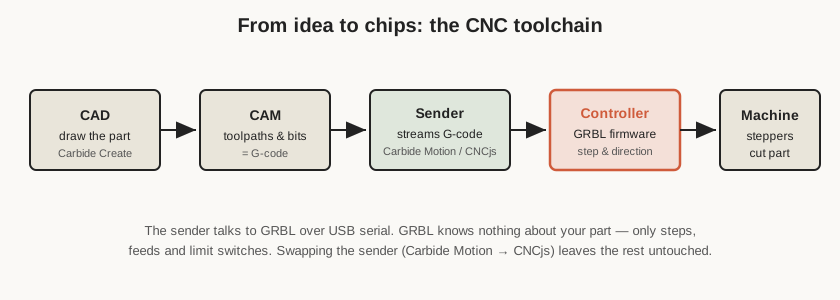
The reason this structure matters here is that it is modular. The design software, the sender, and the firmware are separable. That is why a shop can keep GRBL on the controller but replace Carbide Motion with CNCjs — a browser-based sender that runs on a small dedicated computer, offers scripting and macros, and can be driven from a phone or laptop anywhere on the network. It is why a maker can design in Carbide Create but generate toolpaths in Fusion 360, or vice versa. The Shapeoko’s openness is not just mechanical; the software stack is open too, and this machine’s owner has taken advantage of both.
1.7 What the rest of these volumes cover
The remaining volumes go deep on each part of the story. The next volume dissects the machine mechanically: the frame, the gantry, the V-wheel motion system, the belts, the steppers, the router mount, the wasteboard, and the rigidity realities that flow from all of it. The controller-and-software volume covers the Carbide Motion board, GRBL, the stock and alternative toolchains, the probing accessories, and the case for CNCjs. The modifications volume treats the three headline upgrades — cabinet, lead-screw Z, and CNCjs PC — as general engineering topics with clearly-labelled slots for the owner’s specific build. The using-it volume is practical: workholding, bits, feeds and speeds, tramming, surfacing, dust, and a realistic path from model to finished part. The final volume surveys representative projects, collects the specifications into one table, lays out the maintenance routine, and points to the best further reading. Taken together, they aim to document not just a machine, but a well-understood, thoroughly-modifiable platform — and one particular, heavily-personalised example of it.
Comments (0)