60 W CO2 Laser · Volume 1
Overview — A Large-Format 60 W CO2 Laser in the Model Shop
1.1 What this machine is, in one breath
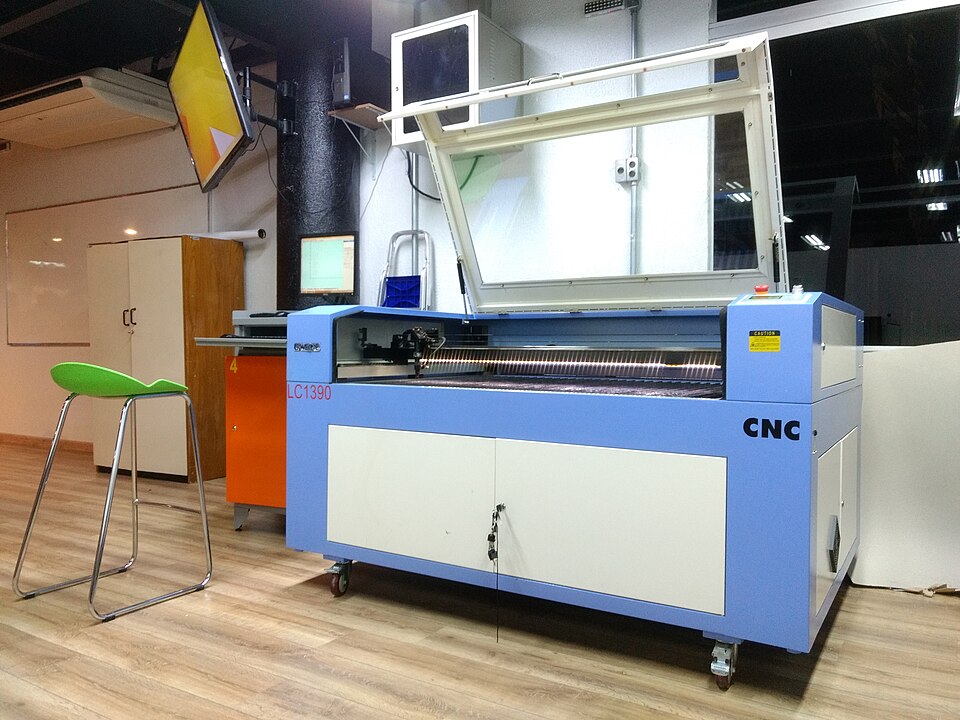
The machine documented in these volumes is a large-format Chinese CO2 laser cutter and engraver rated at about 60 watts, heavily modified over time and mounted on a homemade rolling cart. It is the shop’s tool for turning flat sheet material — acrylic, plywood, hardwood, leather, card, cork — into finished parts by burning through or scorching the surface along a computer-controlled path. Where a milling machine removes material with a spinning cutter and a 3D printer adds it layer by layer, a laser cutter works with light: a beam of invisible infrared energy, focused to a point smaller than a pencil tip, hot enough to vaporise or ignite the surface it lands on. The machine moves that point around a bed, and where the point goes, the material is cut, scored, or engraved.
That simple description hides a surprising amount of supporting machinery, and a genuine set of hazards, both of which get full volumes of their own. A CO2 laser of this class is not an appliance that switches on and runs unattended. It needs water flowing through its laser tube every second it fires, air blowing at the cut, a blower pulling smoke out of the room, and an operator who understands that the same beam that slices 8 mm acrylic will just as happily blind an eye or start a fire. Treated with respect and kept in tune, though, it is one of the most capable and satisfying tools a small maker’s shop can own.
1.2 What a CO2 laser cutter actually does
At the heart of the machine is a sealed glass tube filled mostly with carbon dioxide gas. When a high voltage is applied across it, the gas begins to glow — the same physics as a neon sign, but tuned so that the energy comes out as a tightly organised beam of light rather than a diffuse glow. That beam has a wavelength of 10.6 micrometres, which places it deep in the infrared, far beyond anything the human eye can see. Ten-point-six micrometres matters because it is a wavelength that most organic materials and many plastics absorb extremely well: the light is soaked up right at the surface and converted to heat almost instantly. That is precisely what makes a CO2 laser such a good cutter of wood, acrylic, paper, and leather, and it is also, as later volumes stress, why it is dangerous — the same eager absorption happens in the wet tissue of an eye.
The beam leaves the tube as a straight, invisible pencil of light. It cannot follow the twists and turns of a cutting path on its own, so the machine bounces it off a series of mirrors and finally through a lens that focuses it to a fine point on the workpiece. The mirrors and lens together are called the optics, and the clever arrangement that lets a fixed tube reach every corner of a moving bed — the flying-optics layout — is the signature idea of this whole class of machine. It is described in detail in the next volume; for now it is enough to know that the beam is generated in one fixed place and delivered, by mirrors, to a small head that scoots around above the material.
Where that focused point lands, one of three things happens depending on how fast the head moves and how much power is applied. Move slowly with full power and the beam burns all the way through: a cut. Move faster or at lower power and it only marks the surface: an engrave or score. Sweep the head back and forth like an inkjet printer, firing in a fine pattern of dots, and it reproduces a photograph or logo as shaded burn marks: a raster engrave. All three are just different recipes of speed and power over the same beam, and choosing those recipes well is most of the craft of running the machine.
It is worth pausing on why a laser is the right tool for this and not, say, a fine saw or a router. Because the cutting “tool” is a beam of light, it is effectively frictionless and massless: it never dulls, never deflects a thin part, never pushes the workpiece around, and can turn a corner as sharp as the optics allow with no radius to work around. It leaves a very narrow cut — a kerf a fraction of a millimetre wide — so it nests parts tightly and reproduces fine detail that a physical bit could never reach. And because it is controlled entirely by a file, it cuts a hundred identical parts as easily as one, and just as easily cuts an intricate one-off. The price of those advantages is everything this deep dive is about: a beam hot enough to cut is hot enough to harm, and delivering it reliably takes a tube, high voltage, mirrors, water, air, and exhaust all working together.
1.3 The “large-format Chinese 60 W” category
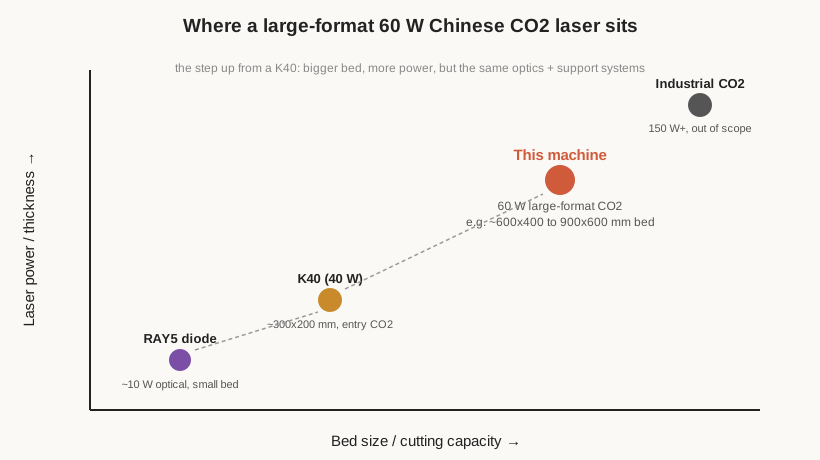
Hobby CO2 lasers cluster into recognisable tiers, and it helps to place this machine within them. The famous entry point is the K40: a small, cheap, blue-and-white Chinese laser with roughly a 40 watt tube and a cutting area of only about 300 by 200 millimetres. The K40 introduced a generation of makers to CO2 lasering, and it is beloved and cursed in equal measure — capable, but cramped, crudely built, and shipped with weak electronics and almost no safety features. Countless K40s have been upgraded piece by piece until little of the original remained.
This machine is the step up from that world. A large-format 60 W cutter keeps the same fundamental recipe — a glass CO2 tube, flying optics, water cooling — but scales it into a bigger, more usable tool: a bed measured in the hundreds of millimetres on each side rather than a cramped tray, a longer and more powerful tube, a proper enclosure, and usually a more serious motion system. Machines in this bracket are sold under a shifting roster of brand names and model numbers by vendors such as OMTech, and by a long tail of generic sellers who ship near-identical cabinets from the same factories. The extra 20 watts over a K40 is not merely a bigger number: it is the difference between struggling with 3 mm material and comfortably cutting 6 to 10 mm acrylic and plywood in a single pass, which is exactly the range most model-shop work lives in.
The word Chinese in the category name is descriptive, not pejorative. The overwhelming majority of hobby and small-business CO2 lasers are manufactured in China, and they represent a genuine bargain: a machine that would have cost tens of thousands of dollars from a Western industrial brand a generation ago can now be had, in this power class, for a small fraction of that. The trade-off is that the machines ship with rough edges — mediocre stock optics, primitive control electronics, casual wiring, and safety features that range from minimal to absent. That gap between what the machine is and what it could be is the reason so many of them, including this one, end up heavily modified. The base machine is a solid, honest platform; the upgrades turn it into a precise, pleasant tool.
1.4 Why this shop has both a CO2 laser and a diode laser
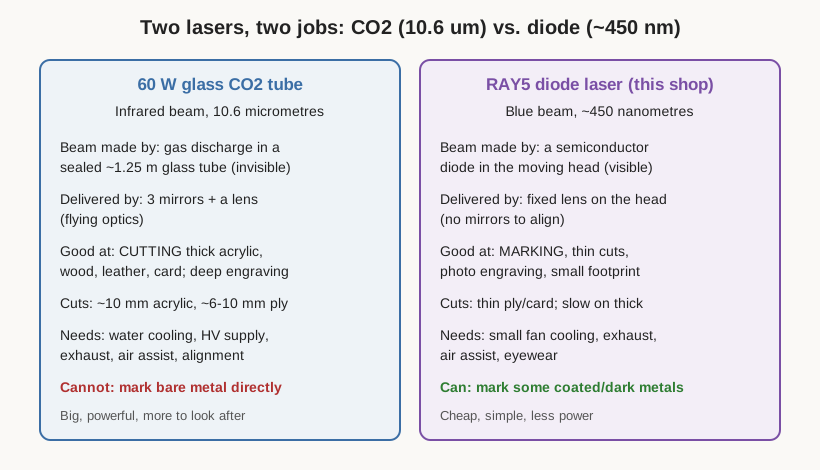
This is a two-laser shop. Alongside the CO2 machine sits a LONGER RAY5, a 10 watt-class diode laser, and the two are not redundant. They work by different physics and are good at different jobs, and understanding the split is the fastest way to understand what the CO2 machine is for.
A diode laser makes its beam directly in a semiconductor chip — the same family of device as the laser in a barcode scanner or a laser pointer, scaled up in power. Its light is blue, around 450 nanometres, and visible (which is why diode machines demand tinted safety glasses and enclosures even though they are far weaker). Because the beam comes straight out of a small emitter, the whole laser rides on the moving head; there are no mirrors to align. That makes a diode machine cheap, light, simple, and forgiving. But blue light is not absorbed nearly as efficiently by clear and light materials, and 10 optical watts is a fraction of what the CO2 tube delivers. A diode laser excels at marking and engraving — logos on wood, photos on slate, scorched artwork — and at slow, thin cuts, and it can even mark some coated or dark metals directly, something the CO2 machine cannot do. What it struggles with is cutting anything thick, and it is nearly useless on clear acrylic, which is transparent to blue light.
The CO2 laser is the opposite trade. It is bigger, thirstier, and needs far more looking-after — water, exhaust, high voltage, mirror alignment — but its 60 watts of eagerly-absorbed infrared cuts where the diode only marks. Thick acrylic that a diode cannot even see becomes clean, flame-polished-edge cutting work for the CO2 tube. In short: the diode is the shop’s marking-and-light-cutting tool, and the CO2 is the shop’s serious-cutting tool. A maker who owns both reaches for the RAY5 to personalise a finished object and for the CO2 laser to make the object in the first place.
1.5 Heavily modified, on a homemade cart
The final defining fact about this particular machine is that it is not stock. Like a great many large-format Chinese lasers, it has been worked on — upgraded, rewired, re-optic’d, and re-housed — until it is a meaningfully better tool than the one that came out of the crate. The specifics of that build are being documented separately and are treated throughout these volumes as clearly marked slots, because inventing them would be worse than useless. What can be said with confidence is the menu of upgrades that owners in this category almost universally reach for, because the stock machines share the same weaknesses.
Chief among them is the controller. Many of these machines ship with an old, closed control board — an M2Nano running Moshidraw-style software, or a similar low-end DSP — that fights the operator at every turn. The single most transformative modification is swapping it for a Ruida DSP controller, which unlocks LightBurn, the industry-standard laser software, and with it real speed-and-power control, layers, and a sane workflow. Beyond the brain, owners typically upgrade the cooling (a real refrigerated chiller instead of a bucket and pond pump), the optics (better mirrors and a cleaner focusing lens with a proper air-assist nozzle), the bed (a honeycomb or blade table), the lighting, and the safety interlocks. All of these are covered as general engineering in the modifications volume.
The homemade cart is its own kind of modification. A large-format laser is heavy and surrounded by services — chiller, air pump, exhaust blower, ducting, power — and a well-built cart gathers all of that into one rolling, self-contained station rather than a sprawl of boxes and hoses on the floor. It is the sort of build that says a great deal about how the machine is actually used, and it is exactly the sort of owner-specific detail these volumes leave room for.
1.6 The kind of work it does
To make the machine concrete, it helps to picture the jobs it earns its place doing. In a model shop a 60 W CO2 laser is the fast route from a drawing to flat parts: it cuts acrylic and plywood panels for enclosures, chassis, and jigs; interlocking tabbed boxes that snap together from a single sheet; gears, brackets, and templates whose intricate outlines would be tedious to make any other way; stencils and masks from card or thin acrylic; and detailed engraving — panel labels, scales, dials, decorative work — on wood, acrylic, and leather. Because it is driven by a file, it turns a laptop full of vector drawings directly into a pile of finished components, and it does so repeatably: the tenth part matches the first. That combination of speed, detail, and repeatability on flat stock is exactly the niche a milling machine or a 3D printer fills less gracefully, and it is why a laser is one of the anchor tools of a well-equipped shop.
Running it, though, is a deliberate act rather than a casual one. A session means switching on the chiller and confirming water is flowing, starting the exhaust blower and the air pump, loading and focusing the material, framing the job to check its placement, and then watching the cut from start to finish with a hand near the stop — because a laser is always, at bottom, a controlled fire. None of that is onerous once it becomes habit, but it is the reason the volumes that follow give the support systems and safety as much attention as the machine itself.
1.7 What the rest of these volumes cover
With the machine placed in its category and its role in the shop established, the remaining volumes go deeper. Volume 2 opens the cabinet and walks the whole beam path in detail — the tube and its high-voltage supply, the three mirrors and the lens, the gantry and motors, the controller, and the bed. Volume 3 covers the support systems that make the machine work at all and are emphatically not optional: water cooling, air assist, exhaust and fume extraction, and the electrical and interlock story, along with how they get upgraded and integrated on a modified machine. Volume 4 covers the modifications themselves as general engineering, with owner slots, and then the LightBurn workflow from imported file to finished part. Volume 5 is the reference and safety volume: eye and fire safety, the material do-and-do-not lists and the chemistry behind them, alignment and cleaning, tube life and consumables, and a specifications summary with the owner’s specifics left as slots.
The thread running through all of it is that a large-format CO2 laser rewards a maker who understands it as a system — beam, motion, cooling, air, exhaust, and software — rather than a magic box. The chapters that follow build that understanding one subsystem at a time.
Comments (0)