HiTorque 3990 Mini Mill · Volume 1
HiTorque 3990 Mini Mill — Overview: A Manual Mill in a CNC Shop
1.1 The odd machine out
Walk into this shop and most of what is bolted to the benches carves metal or wood on its own. The Nomad 3 and the Shapeoko trace toolpaths that a computer sent them; the operator loads stock, presses go, and watches. The HiTorque 3990 mini mill is different. It is a manual milling machine: nobody writes G-code for it, no stepper motors drive its axes, and the only intelligence in the loop is the pair of hands turning the handwheels. That makes it, at first glance, the least glamorous tool in the room. In practice it is one of the most used, because a manual mill answers a class of questions that a CNC machine answers slowly or not at all — squaring up a rough casting, drilling a bolt circle, facing a part flat, cutting a keyway, spotting a hole, or making the one bracket you need in the next ten minutes without opening a CAM program.
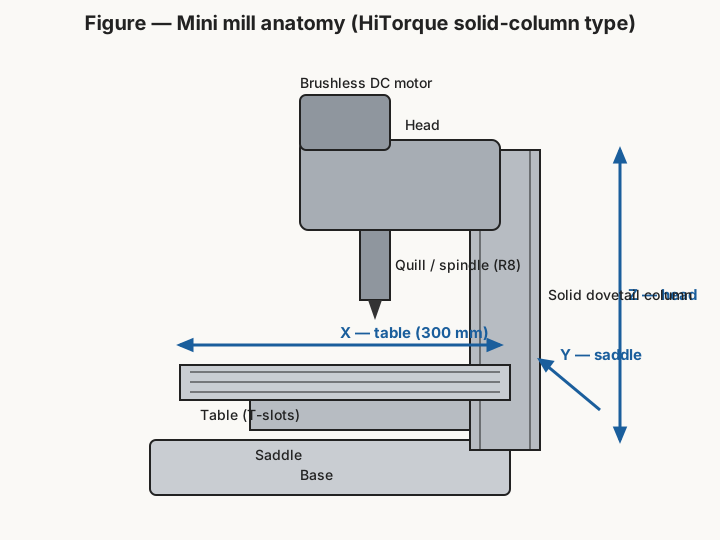
A milling machine, in the most general sense, holds a rotating cutter in a vertical spindle and moves a workpiece past it on a table that travels in two horizontal directions (X and Y) while the cutter head moves vertically (Z). Where a lathe spins the work against a stationary tool, a mill spins the tool against stationary work. That inversion is what lets a mill produce flat faces, slots, pockets, steps, and precisely located holes on a part clamped to its table. The cutter — most often an end mill, a fluted cylindrical tool that cuts on both its end and its sides — removes material as the table feeds it into the rotation.
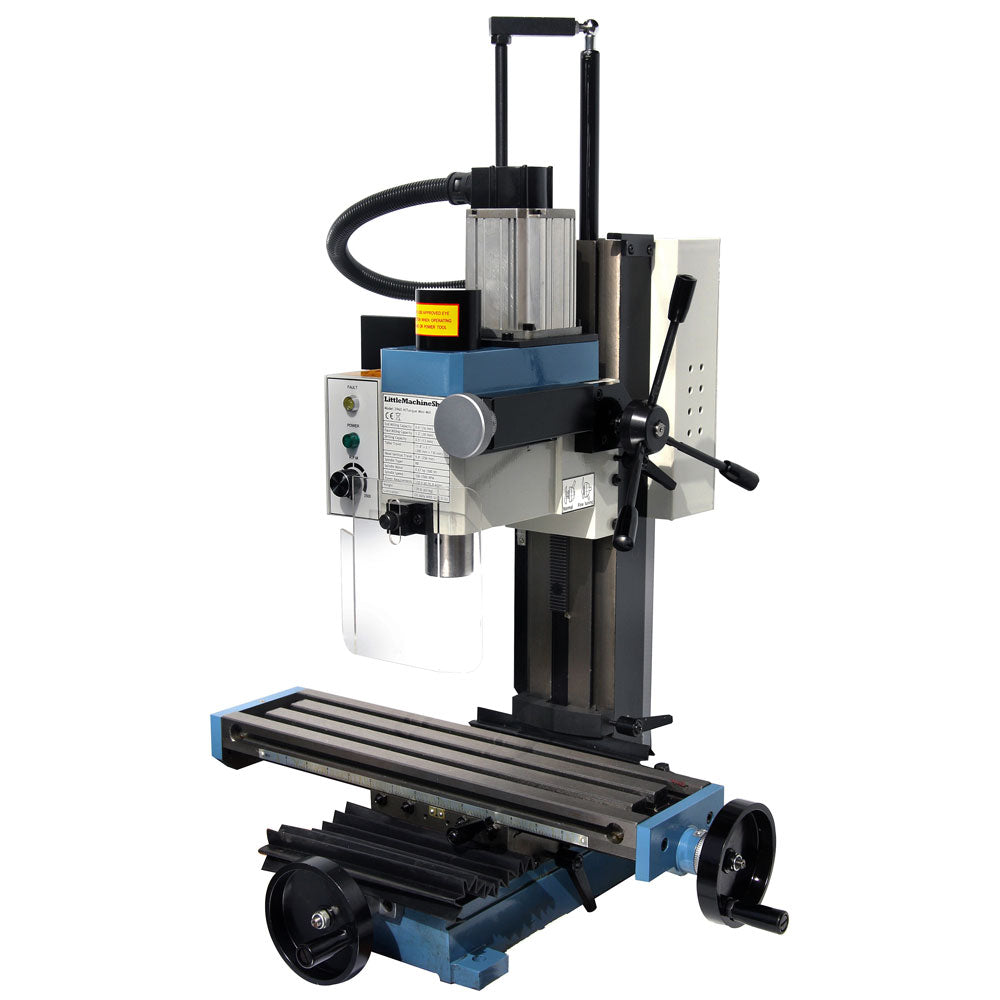
A mini mill is simply the smallest practical size of this machine: a benchtop vertical mill weighing on the order of 50 to 90 kg, descended from the Sieg X2 pattern that has been sold under dozens of badges since the 1990s. It trades the rigidity and envelope of a full knee mill for the ability to sit on a sturdy bench, run from a standard wall outlet, and cost a fraction as much. Within that class, the HiTorque line from LittleMachineShop (LMS) sits at the capable end, and the 3990 is LMS’s current flagship mini mill.
1.2 What “HiTorque” actually means
The mini-mill lineage matters because it explains what LMS changed and why the 3990 is worth singling out. The classic Sieg X2 — the machine most people picture when they hear “mini mill” — uses a brushed DC motor turning the spindle through a two-stage gear train, with a lever to shift between a low and a high speed range. Those gears are the machine’s weak point. They are noisy, they strip if the spindle stalls, and the plastic ones fitted to many X2s are a well-known consumable. The original X2 also used a round column: the head rides up and down a cylindrical post, which means that raising or lowering the head can let it rotate slightly around that post and lose alignment with the table — a genuine nuisance when a drilling job forces a big Z move mid-setup.
The HiTorque design addresses both problems. “HiTorque” refers to the brushless DC (BLDC) motor LMS specified in place of the brushed-and-geared drive. On the 3990 that motor is rated 500 watts (about 0.67 hp) and drives the spindle through a single toothed belt rather than a shiftable gearbox. A brushless motor with an electronic controller holds usable torque across a wide speed range, so the spindle is continuously variable from roughly 100 to 2500 rpm with a single dial and no gears or belts to shift. There is no low-range/high-range lever because the machine does not need one: the controller simply delivers the commanded speed, and the low-end torque that gives the line its name lets it swing a fly cutter or a larger end mill at low rpm without bogging.
The second HiTorque change is structural. The 3990 uses a solid column — a fixed, non-tilting dovetail column that is an entirely different and heavier casting than the old tilting/round column, with thicker walls and a stiffer joint to the base. Because the head cannot rotate around the column, alignment is preserved through Z moves, and the extra mass and the dovetail ways make the whole machine noticeably more rigid than a round-column X2. The trade-off is that a solid-column head does not tilt for angled work the way a nodding-head mill does, but for the overwhelming majority of jobs that a mini mill sees, rigidity and repeatability are worth far more than the ability to tilt the head a few degrees.
1.3 The 3990 specifically
Numbers give the 3990 its shape. The headline figures, taken from the LMS product listing, are these:
- Spindle taper: R8. The 3990 uses an R8 spindle — the same taper found on a full-size Bridgeport — rather than the MT3 (Morse taper No. 3) fitted to some older or smaller mini mills. R8 is the more convenient and more widely tooled choice; more on why in Volume 2.
- Motor: 500 W (0.67 hp) brushless DC, single-belt drive, 100–2500 rpm continuously variable.
- Table: 18.1 in × 4.7 in (460 mm × 120 mm) — LMS’s larger table, which they cite as roughly 50% more table area than a standard mini mill, with three 12 mm (0.472 in) T-slots.
- Travels: X = 300 mm (11.8 in), Y = 130 mm (5.1 in), Z = 270 mm (10.6 in). The X travel in particular is generous for the class, about 30% more than a typical X2.
- Capacities: 16 mm (0.63 in) end milling, 30 mm (1.18 in) face milling, 13 mm (0.5 in) drilling.
- Throat (spindle centreline to column face): 165 mm (6.5 in). Maximum spindle-nose-to-table distance: 292 mm (11.5 in).
- Head support: an air spring takes the weight of the head, so raising and lowering it is smooth and the head does not slam down if the coarse feed is released.
- Z-axis fine feed with a resolution of about 0.001 in per graduation, plus drill-press-style coarse levers for fast head motion and drilling.
- Weight: about 124 lb (56 kg). Footprint roughly 23 × 20 in, standing about 36 in tall. It runs from a 120 V, 60 Hz, 8 A outlet.
Those specifications place the 3990 as a serious small mill rather than a toy. Sixteen millimetres of end-mill capacity in steel is real capability; 300 mm of X travel means a part can be repositioned and re-clamped less often; and the brushless drive means the machine will chew through aluminium happily and take respectable cuts in mild steel with appropriate speeds, feeds, and patience. What it is not is a production machine or a substitute for a knee mill: the envelope is small, the mass is modest, and heavy cuts in hard material demand light passes. Understanding those limits is most of what separates satisfying work on a mini mill from broken cutters.
1.4 Where it fits in this shop
This shop is organised around making things — parts for the other machines, fixtures, enclosures, brackets, and the occasional finished object — and the tools fall into two camps. The CNC routers and mills (the Shapeoko for larger, softer material and the Nomad for small, precise metal and plastic work) are for parts that are either too intricate to cut by hand or needed in more than one identical copy. The HiTorque 3990 is the manual counterpart, and it earns its bench space precisely because it is not automated.
Several kinds of job go to the mini mill first. Stock preparation is the biggest: squaring a sawn or cast blank so that a later CNC operation has known, flat, perpendicular reference faces. One-offs — a spacer, a motor mount, a clamp — are usually faster to knock out by hand than to draw, CAM, and set up. Drilling and boring to a located position is a natural manual-mill task: the table and the readout put a hole exactly where it belongs far more accurately than a drill press. And operations that want a human in the loop — feeling a cut, sneaking up on a dimension, deburring an edge under power — are simply more pleasant and often safer done manually.
Crucially, the mini mill and the CNC machines are complementary, not redundant. A part might be roughed and squared on the 3990, finished on the Nomad, and returned to the mini mill to have a cross-hole drilled — each machine doing the step it does best. Keeping a capable manual mill in a CNC-heavy shop is not nostalgia; it is what keeps the CNC machines free for the work that actually needs them.
There is also a learning dimension that the manual machine supplies and the CNC machines cannot. On a router or CNC mill the cut is abstract — a simulated path, a feed rate typed into a post-processor. On the 3990 the operator feels the cut directly through the handwheels: the change in resistance as a tooth engages, the buzz that warns of chatter, the way a cut lightens as the material comes to size. That tactile feedback is how a maker builds intuition for speeds, feeds, and depth of cut, and that intuition then makes the CNC work better too, because the numbers typed into CAM are grounded in what the operator has actually felt a cutter do. A manual mill is, in that sense, the machine on which the rest of the shop’s judgement is trained.
The 3990 also sits at a deliberate point in the size/rigidity trade. It is bigger and stiffer than the toy-grade mills that share its lineage, but it remains a benchtop machine that one person can lift into place and run from a wall outlet — no three-phase supply, no rigging, no dedicated floor space. That combination of real capability and low overhead is exactly why the mini mill, rather than a second-hand knee mill, is the manual machine in this shop: it does the manual jobs that come up without demanding the room, the power, or the mass that a full-size mill would.
1.5 The upgrade that defines this machine
A stock mini mill has one persistent weakness that has nothing to do with its castings or its motor: you cannot easily tell where the table is. Position on each axis is read from graduated dials on the handwheels, and those dials lie in two ways. First, they only count turns and fractions of a turn, so keeping track of absolute position across many moves is entirely on the operator’s memory and arithmetic. Second, and worse, every leadscrew has backlash — lost motion between the screw and its nut — so reversing an axis turns the dial some amount before the table actually moves. On a manual mini mill that backlash can be several thousandths of an inch, and mentally subtracting it on every direction change is exactly the kind of bookkeeping that turns a good part into scrap.
The answer, and the modification that defines this machine, is a digital readout (DRO): a set of linear scales that measure the true position of each axis directly, independent of the leadscrews, and a display that shows all three coordinates at once. Because a linear scale reads the table’s actual movement, backlash simply disappears from the reading — reverse the handwheel and the number does not move until the table does. Absolute and incremental coordinates, zeroing an axis anywhere, and returning to a remembered position all become trivial. A DRO does more to make a manual mill accurate and pleasant to use than almost any other single upgrade.
This machine’s DRO is not a bolted-on commercial box with a fixed display. It is a TouchDRO installation — an open, Android-based digital readout created by Yuriy Krushelnytskiy (Yuriy’s Toys). In a TouchDRO system, inexpensive linear scales feed their position signals to a small adapter board, and the adapter streams the coordinates over Bluetooth to a free Android app running on an ordinary tablet, which becomes the readout. This shop’s 3990 uses magnetic linear scales on all three axes — a chip- and coolant-tolerant type well suited to a mill — read by a TouchDRO TDA-400 adapter, with the app on a tablet mounted beside the head. The engineering of that installation, why magnetic scales were chosen over glass, and how the scales mount to the three axes are the subject of Volume 3.
1.6 Reading order
The volumes that follow build on this overview. Volume 2 takes the machine apart on paper — base, column, head, spindle and taper, quill and fine feed, the table and its travels, the brushless drive, tramming the head, and what the machine can and cannot cut. Volume 3 covers the DRO modification in depth: why a DRO transforms a manual mill, what TouchDRO is, how magnetic scales compare to glass and capacitive types, and how the scales, the TDA-400 adapter, and the tablet go together — with clearly marked slots for this shop’s specific parts and install photos, which are still to come. Volume 4 is about using the machine: milling operations, workholding, tooling, climb versus conventional cutting, tuning the gibs and backlash, and how the DRO changes the day-to-day workflow. Volume 5 is the reference shelf: a full specifications table, a parts overview for the DRO, a maintenance schedule, and links for going deeper.
The through-line is simple. The HiTorque 3990 is a well-chosen manual mini mill — brushless, solid-column, R8, with a generously sized table — made genuinely precise by a TouchDRO retrofit. It is the shop’s answer to every job that wants a human hand and an honest, absolute position readout rather than a program.
Comments (0)