HiTorque 7×16 Mini Lathe · Volume 1
Overview — What a Mini Lathe Is, and Why the HiTorque 7×16
1.1 The lathe, reduced to its essentials
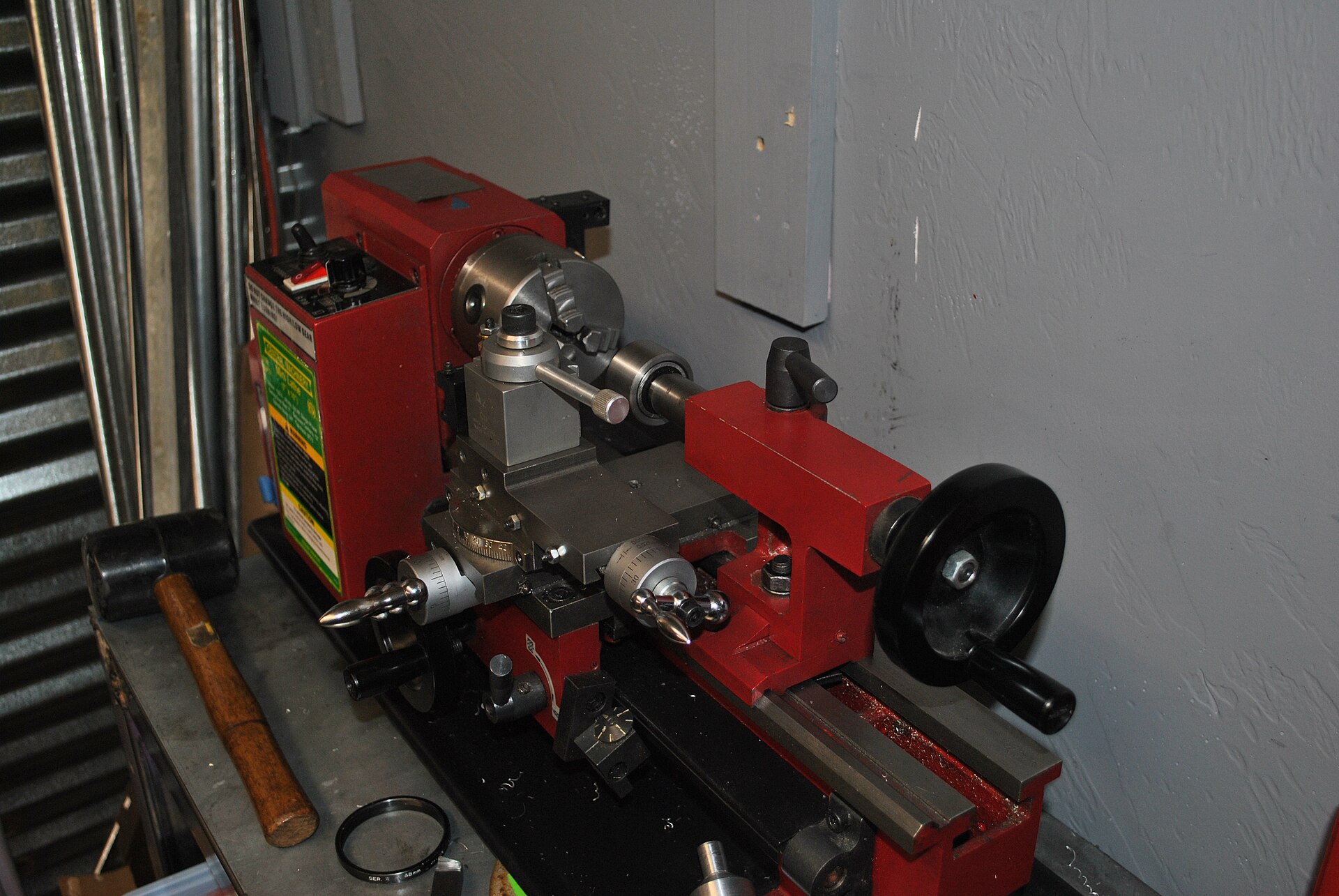
A lathe is the oldest and most fundamental of the machine tools: it spins a workpiece about a fixed axis while a rigidly supported cutting tool is fed against it, removing material to produce a surface of revolution. Almost everything a lathe makes shares that one geometric fact — it is round, or built from round features. Shafts, bushings, bearing journals, threaded studs, knobs, pulleys, spacers, pins, and the countless small turned parts that hold a model or a machine together all begin as a cylinder gripped in the spindle and shaped by a tool that the operator advances with a pair of hand-wheels. The spindle supplies the cutting speed; the tool supplies the shape.
That description covers a room-filling engine lathe and a machine that fits on a corner of a workbench equally well. What separates them is size, mass, and power — and it is precisely at the small end of that range that the “mini lathe” lives. A mini lathe is a bench-top metal-cutting lathe, typically weighing somewhere between forty and sixty kilograms, that can turn steel, brass, aluminum, and plastics within a modest envelope. It is not a wood lathe and not a watchmaker’s lathe; it is a real, screw-cutting metalworking lathe scaled down to what one person can lift onto a bench and run from a domestic wall outlet. For a model shop — a shop that makes small, precise mechanical parts rather than production runs — it is often the single most useful machine on the floor.
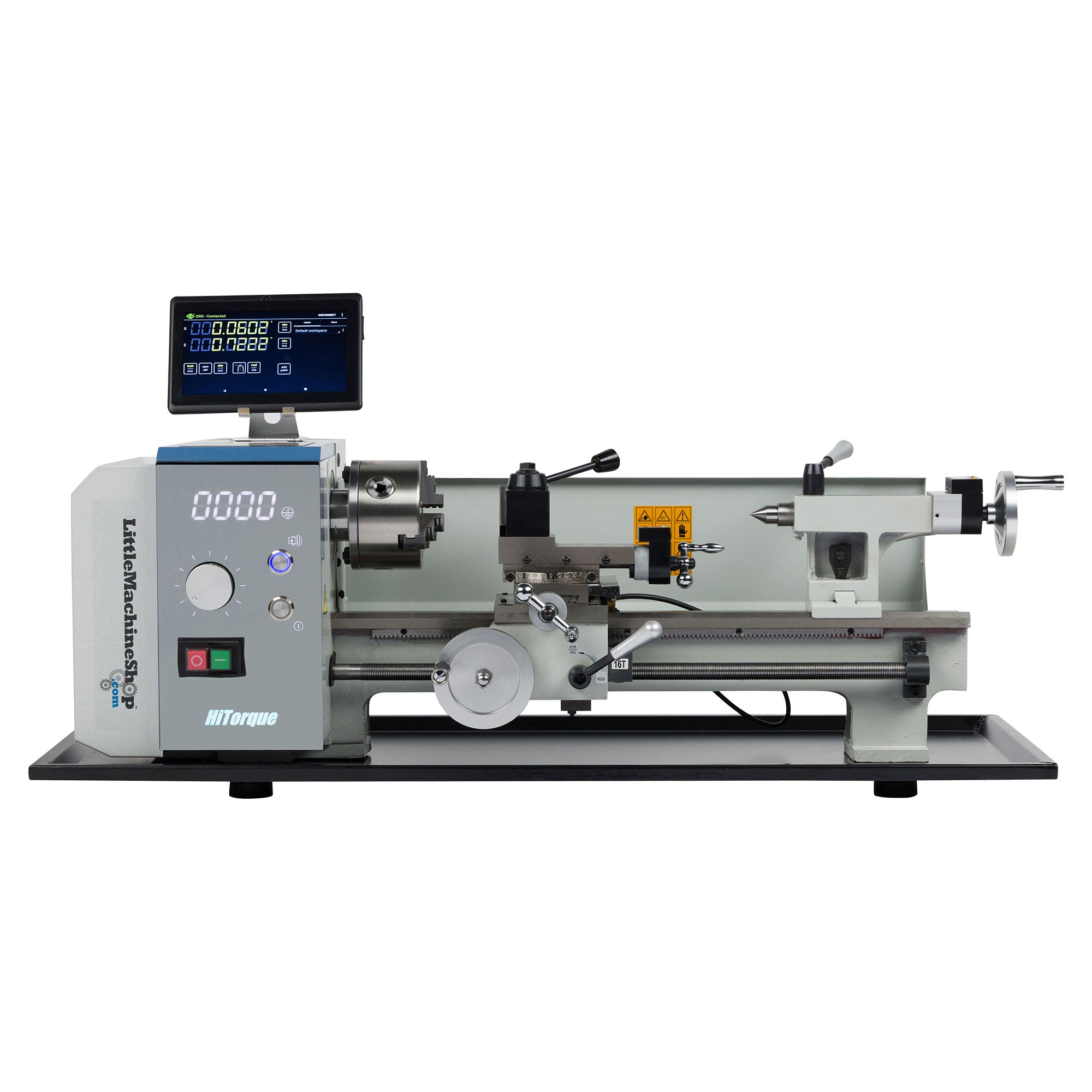
The machine this deep dive documents is a specific and well-equipped example of the breed: the HiTorque 7×16 Deluxe Mini Lathe, sold by LittleMachineShop (LMS) as model 7450, the version with the illuminated “mirror” control display, and carrying the factory designation SC20. Before getting into what makes this particular lathe worth choosing, it is worth understanding the family it belongs to, because the mini-lathe world is full of near-identical machines wearing different colors and badges, and the differences that matter are not the ones the paint suggests.
1.2 The 7×N mini-lathe family
Nearly every small metal lathe sold under a hardware-store or hobby brand in the last three decades traces back to a common ancestry: a line of bench lathes designed and built by SIEG in China and distributed worldwide under a long list of names — Grizzly, Central Machinery (Harbor Freight), Micro-Mark, Clarke, BusyBee, Cummins, and many others. Because so many of these machines are mechanically the same casting set with cosmetic changes, the hobby-machinist community long ago stopped referring to them by brand and started describing them by their working envelope: the “7×10,” “7×12,” “7×14,” and “7×16” mini lathes.
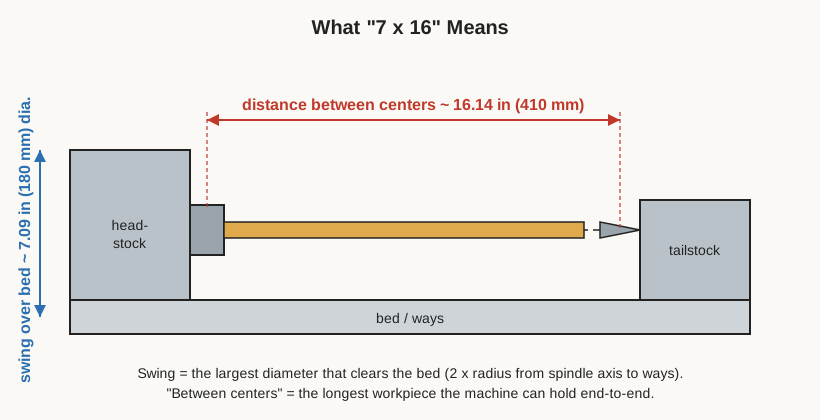
The two numbers are the two dimensions that define what a lathe can hold. The first — 7 — is the nominal swing over the bed, roughly the largest diameter of workpiece that will clear the bed ways as it rotates. On these machines the real figure is about 7.1 inches (180 mm) of swing, i.e. a workpiece a little over seven inches in diameter can, in principle, spin without fouling the bed. The second number is the distance between centers: the longest workpiece the machine can carry end-to-end, gripped in the spindle at one end and supported by the tailstock center at the other. A “7×10” holds about ten inches between centers; a “7×16” holds about sixteen.
Critically, across the whole 7×N family, the swing is essentially unchanged — the headstock, spindle, cross-slide, and the vertical geometry are shared. What grows as the second number climbs is almost entirely bed length. A 7×16 is a 7×12 (or 7×14) on a longer bed casting with a longer lead screw. That extra bed is not a trivial luxury: it is the difference between being able to turn a full-length shaft and having to make it in pieces, and it also leaves room for the tailstock and a drill chuck without crowding the carriage. The longer bed is one of the genuine, functional reasons to prefer a 7×16 over the shorter and often cheaper 7×12 and 7×14 machines that otherwise look identical.
This shared ancestry also explains the alphanumeric designations that appear alongside the marketing names. The original brushed machines carried factory codes in the “C” series (the small bench lathe long sold as the “C2” or “C3,” for example); the brushless machines that superseded them took “SC” codes — hence the SC20 designation this 7×16 also carries. LittleMachineShop’s “HiTorque 7×16” and the factory “SC20” are the same machine seen from the vendor’s and the maker’s ends of the supply chain, and knowing that helps a reader cut through the thicket of overlapping names to recognize when two listings are, mechanically, the same lathe. The lesson the community draws from all this is to shop by the specifications and the drivetrain rather than the badge: a machine’s swing, its distance between centers, and above all whether it is brushed-and-geared or brushless tell you far more about what you are buying than the brand on the chip tray does.
It is easy to be misled by the family resemblance. A 7×12 and this 7×16 can share a chuck, a tool post, tooling, and most spare parts, and the community wisdom accumulated over decades of the shorter machines applies almost verbatim. But they are not interchangeable in capacity, and — more importantly for this machine — they are not necessarily the same underneath the sheet metal. The single most consequential split in the mini-lathe family is not bed length at all. It is what drives the spindle.
1.3 The old drivetrain, and its limits
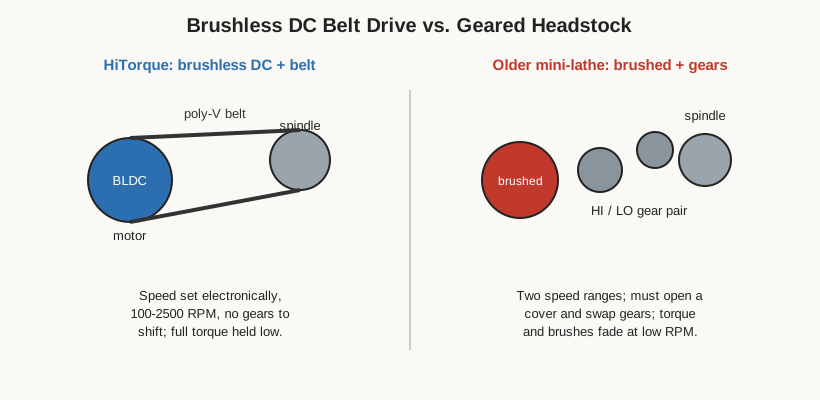
The classic mini lathe of the 2000s used a brushed DC motor feeding a two-speed gear train inside the headstock. The operator picked a “high” or “low” range by opening a cover and physically swapping a pair of change gears, then used a speed-control knob to vary the motor within that range. This arrangement worked, and a great many good parts have been made on such machines, but it carried three well-known frustrations that anyone who has run one will recognize.
First, torque collapsed at low speed. A brushed DC motor driven slowly makes little torque, and small-diameter or interrupted cuts at low RPM — exactly what heavier materials and larger tools demand — could stall the spindle or force the operator up into a faster range than the cut really wanted. Second, the brushes and small commutator were a wear-and-heat item: they eventually needed replacing, and they were a recurring source of the sudden control-board failures that plagued early machines. Third, the gear change was a chore: reaching a very low speed or a very high one meant stopping, opening the headstock, and moving gears, and the plastic gears used in some machines were themselves a known weak point that could strip under a heavy or shock load.
The mini lathe was good enough despite these things because the alternative was a machine ten times the size and price. But the drivetrain was clearly the part most ready for improvement, and that is exactly where the HiTorque line was aimed.
1.4 Why “HiTorque”: the brushless line
LittleMachineShop’s HiTorque machines — both their mini lathes and their mini mills — are built around a brushless DC (BLDC) motor driving the spindle through a belt, with no gear train in the spindle drive at all. That single change is the reason the line exists and the reason its name is what it is, and it addresses all three of the old drivetrain’s weaknesses at once.
A brushless motor has no brushes and no mechanical commutator; commutation is done electronically by the controller, which senses rotor position and switches the windings in sequence. The practical consequences for a lathe are direct. The motor can hold high torque down to low speed — the “HiTorque” claim — so heavy cuts and large-diameter facing no longer force the operator into a faster range. There is nothing to wear out and arc the way brushes do, so the drive runs cooler, quieter, and more reliably. And because the electronic controller sets the speed directly, the machine offers one continuous speed range across its whole span rather than two mechanically-selected bands: on this machine, 100 to 2500 RPM, adjustable on the fly and available in both directions, with no gears to shift. A single poly-V belt from the motor to the spindle is the only reduction in the path.
For a maker, the effect is qualitative, not just a spec-sheet improvement. Threading up to a shoulder at 120 RPM, parting off a stubborn piece of steel, or facing a large aluminum disc — all the operations that made the old geared machines feel underpowered at the bottom of their range — become routine, because the torque is simply there where it is needed. The absence of the gear change also removes a whole category of interruption and a whole category of failure (stripped or mis-meshed gears) from daily use. This is the core of why the HiTorque family is worth its premium over the generic brushed machines, and it is the feature to keep in mind through the rest of this deep dive, because much of what the “Deluxe” 7450 layers on top only makes sense once the drivetrain underneath is this capable.
1.5 The 7×16 Deluxe (7450 / SC20), specifically
Within the HiTorque 7×16 range, LMS sells several trim levels off the same core machine. The base model (5100) gives the brushless drive and the long bed. The step up (7350) adds a wedge-type quick-change tool post and a digital position readout on the cross slide. The machine documented here — the 7450, the “Deluxe” with the mirror display — is the fully-equipped version, and its additions are worth naming because they are what a reader will actually touch every time they use it.
The headline is the LED “mirror” control panel: a dark glass fascia across the headstock front on which the illuminated controls appear to float. It carries an illuminated start/stop button, a spindle-direction button, an emergency-stop (E-stop) switch, the variable-speed knob, and an integrated digital tachometer that reads out actual spindle RPM. Compared with the scattered switches of a base machine, it puts the controls the operator reaches for constantly in one clear, lit place — a small ergonomic thing that matters a great deal in day-to-day use.
The 7450 also ships with a two-axis digital readout (DRO) that is unusual for a machine this size: magnetic scales are factory-fitted to the longitudinal (carriage) and cross-slide feeds, and they report position over Bluetooth to a tablet running a DRO display, supplemented by digital readouts on the compound rest and tailstock and a 40-division graduated dial on the cross slide. A DRO transforms how a small lathe is used — turning a diameter to a number rather than counting hand-wheel graduations and fighting backlash — and having one integrated from the factory, rather than bolted on later, is a defining feature of this trim.
Rounding out the “Deluxe” package are the workholding and control refinements: a 0XA wedge-type quick-change tool post with five tool holders (so a tool can be swapped and returned to the same height in seconds), aluminum hand-wheels and chrome levers that are larger and pleasanter to use than the plain plastic knobs of budget machines, and quality NSK spindle bearings for smooth, quiet running. The machine weighs about 108 lb (49 kg) and runs from a standard 120 V, 60 Hz, 8 A outlet.
1.6 Where it fits in a model shop
A model shop is defined less by what it makes than by how it makes it: one-off and small-batch parts, to real tolerances, in a variety of metals and plastics, on a bench rather than a factory floor. The mini lathe sits at the center of that work because so many small mechanical parts are, at heart, turned parts — and because a lathe is one of the few machines that can make a part more accurately than the machine’s own hand-wheels, once the operator understands how to work to a shoulder, a center, or a dial.
In the shop this machine lives in, the 7×16 is the general-purpose turning tool: it makes the bushings, spacers, shafts, arbors, adapters, knobs, and threaded parts that the shop’s other machines — the CNC router, the mill, the coil winders, the printers — need in order to be built, mounted, and modified. Its long-for-the-class bed lets it handle the occasional slender shaft; its brushless torque lets it take a genuine cut in steel rather than only skimming soft metal; and its factory DRO and quick-change tooling make short setups fast, which is exactly what one-off work rewards. The chapters that follow work through the machine in detail — its anatomy and drive, the tooling that extends it, the techniques and tuning that make it accurate, and the parts it is asked to produce — but the reason it is here is simple: for the kind of small, precise, varied metal work a model shop does, a well-equipped 7×16 mini lathe does more, per pound and per dollar, than almost anything else that fits on the bench.
It is also worth being honest about why a maker chooses this class of machine at all, rather than a larger used lathe for similar money. The mini lathe wins on three practical grounds. It is liftable and bench-mountable — one person can put it on a bench, and it runs from an ordinary household outlet, so it needs no three-phase supply, no rigging, and no dedicated floor. It is new, supported, and consistent — bought from a vendor like LMS it comes with a warranty, a parts supply, a user’s guide, and a catalog of accessories built to fit, where a bargain used machine may arrive worn, incomplete, or missing the change gears that make it a screw-cutting lathe. And it sits inside an enormous body of community knowledge accumulated over decades of nearly-identical machines, so almost any question of setup or technique has already been answered in detail. For a shop whose work is small parts rather than large ones, those advantages outweigh the raw capacity a bigger machine would offer, which is exactly why the well-equipped mini lathe has become the default first metal lathe for the serious hobbyist and the model maker.
A note on the numbers used throughout this deep dive: all quoted specifications are taken from LittleMachineShop’s published data for the model 7450, and are called out as such where they matter. Where a figure describes the mini-lathe family in general rather than this machine specifically, that is stated. Nothing here is estimated in place of a published value.
Comments (0)