LONGER RAY5 10W · Volume 1
The LONGER RAY5 10 W — an overview of a blue-diode engraver
1.1 A small blue laser that earns its bench space
The LONGER RAY5 10 W is a desktop diode laser engraver and light-duty cutter. In this shop it sits alongside a much larger 60 W CO2 machine, and the two are not rivals so much as different tools that happen to share a working principle: both steer a focused beam of light across a workpiece and burn, vaporize, or chemically change the surface it touches. Where they differ — in wavelength, in raw power, in footprint, in cost, and above all in what materials they can process — turns out to matter a great deal, and understanding that difference is the fastest way to understand why a shop with a capable CO2 laser still keeps a little blue diode on the bench.
The RAY5 is an open-frame machine. There is no cabinet, no lid, no interlocked door. It is an aluminium-extrusion gantry — two side rails, a cross beam, a few stepper motors, a controller, and a laser module hanging from the moving carriage — bolted together into a rectangle a little under 600 mm on a side. That openness is central to its character. It makes the machine cheap, light, and endlessly accessible for tinkering, and it makes eye protection non-negotiable, because a Class 4 laser with nothing between its beam and the room is pointed at whatever happens to be nearby. More on that in the safety volume; it is worth stating up front that this is a serious laser in a friendly-looking package.
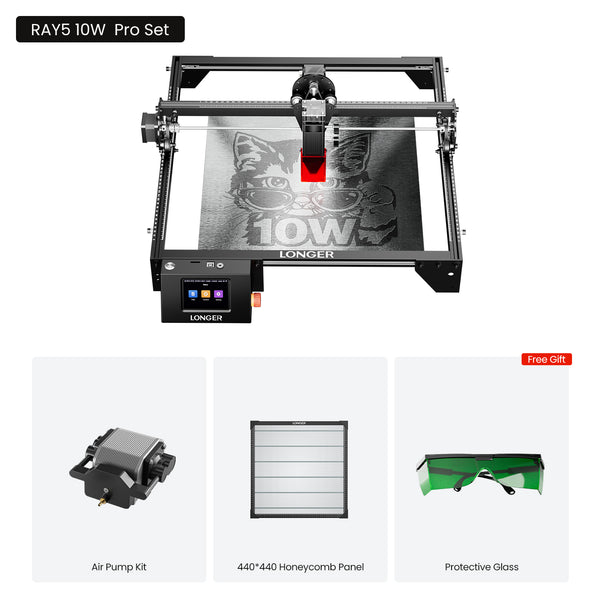
The headline number is “10 W,” and that number deserves immediate clarification because it is the single most misunderstood spec in the hobby-laser market. The 10 W is optical output power — the light energy leaving the lens — not the electrical power the machine draws from the wall, and not a marketing exaggeration of a weaker part. It is also not produced by a single 10 W laser diode, because a blue laser diode that powerful and that beam-clean does not exist at this price. Instead the module combines the beams of two separate diodes, each on the order of 5 to 6 W optical, into one focused spot. The distinction between combined optical output and wall power, and why LONGER can honestly print “10 W” on the box, is the subject of its own section below.
1.2 What a diode laser engraver actually is
A laser engraver is a two- or three-axis motion platform carrying a light source intense enough to modify a surface. The RAY5’s motion system is a classic Cartesian gantry: a stepper motor drives the cross beam back and forth along the machine’s depth (the Y axis), a second stepper drives the laser carriage left and right along that beam (the X axis), and the laser module rides on a manually adjustable vertical mount (a limited Z). The controller reads a stream of G-code — the same numerically controlled motion language used by CNC mills and 3D printers — and for every move it commands, it also commands a laser power level. Draw a line at 80 % power and 3000 mm/min and the machine burns a line of a particular darkness and depth; sweep the head back and forth across an area while modulating power point by point, and a photograph appears in scorched wood.
The light source in a diode engraver is a semiconductor laser: an electrically pumped diode, essentially the same family of device as the emitter in a Blu-ray drive or a laser pointer, but far more powerful and actively cooled. When current flows through the diode’s junction it emits coherent light; a small lens assembly focuses that light to a tight spot a fraction of a millimetre across. The RAY5 10 W focuses to a rated spot of roughly 0.06 by 0.06 mm, which is genuinely fine — fine enough for legible small text and detailed photo engraving. Because the whole emitter is a chip and a lens rather than a metre-long glass tube, the module is small enough to hang from a moving carriage and light enough not to slow the gantry down. That compactness is the diode laser’s defining advantage.
That G-code lineage is worth dwelling on for a moment, because it explains why the RAY5 slots so easily into a mixed shop. The same numerically controlled vocabulary that drives the CNC router, the mini mill, and the 3D printers on the other benches also drives this laser: coordinates, feed rates, and — in the laser’s case — a spindle-speed command repurposed to mean laser power. A maker already fluent in one of those machines is most of the way to being fluent in this one, and the design tools overlap too, since vector art destined for the CNC or a cutter can often be repurposed for the laser with little more than a change of output driver. The laser is, in that sense, less an exotic new discipline than another head on the same family of motion platform.
The wavelength — the colour of the light — is the diode laser’s defining constraint. The RAY5 emits at about 445 to 450 nm, deep blue, right at the edge of visible light. That is important because a laser only does work on a material that absorbs its wavelength. Blue light is readily absorbed by dark, organic, and matte surfaces: wood chars, leather browns, paper burns, dark paint and anodizing ablate. It is poorly absorbed by things that are transparent to blue or that reflect it: clear acrylic lets the beam pass straight through, clear glass barely notices it, and shiny bare metal throws most of it back. This single fact governs the entire materials story of the machine, and it is the deepest reason a diode laser and a CO2 laser are not interchangeable.
1.3 Diode versus CO2 — why this shop runs both
The CO2 laser in this shop is a sealed glass tube excited by high voltage, and it emits at 10.6 µm — far infrared, an invisible wavelength more than twenty times longer than the diode’s blue. That long wavelength is absorbed strongly and almost indiscriminately by organic materials and, crucially, by clear acrylic and glass, which are effectively opaque at 10.6 µm even though they look transparent to the eye. Combine that broad absorption with the CO2 machine’s much higher power — 60 W here, water-cooled, with plenty of headroom — and the result is a laser that cuts: 10 mm cast acrylic in a single clean pass, thick plywood, cardboard, fabric, and more, with cut edges on acrylic that come out flame-polished and glassy.
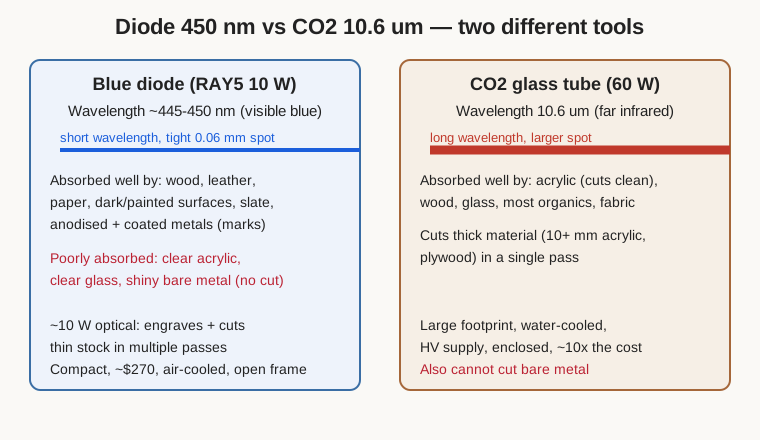
The RAY5 cannot match that cutting ability, and it would be unfair to ask it to. A 10 W diode cuts thin stock — a few millimetres of plywood, thin acrylic, leather, veneer — by making several slow passes, each removing a little more material. LONGER rates the 10 W module as capable of eventually cutting up to roughly 20 mm basswood or 30 mm acrylic given enough passes, but “capable given enough passes” and “practical for production” are different claims; for real work the diode’s cutting sweet spot is thin material, and thick cuts belong on the CO2.
So why keep the diode at all? Several reasons, each of which the CO2 cannot answer as well. First, cost and convenience: the RAY5 is roughly a tenth of the price of a comparable CO2 setup, needs no water cooling, no exhaust chiller, and no high-voltage supply, and it powers up in seconds for a two-minute job. Second, spot size and detail: at 0.06 mm the diode’s spot is finer than a typical CO2 focus, and for small photo-realistic engravings and fine text it can hold detail beautifully. Third, and decisively, metal marking. The far-infrared CO2 beam reflects off bare metal and does essentially nothing useful to it. The blue diode, by contrast, is absorbed well enough by dark and coated metals to be genuinely useful: it ablates the dye from anodized aluminium to leave crisp light-on-dark marks, and with a metal-marking spray or compound it will mark bare steel, brass, and stainless. A CO2 laser in this class simply will not do that. The diode is therefore the shop’s tool for marking metal and for fine work on small organic pieces, while the CO2 remains the tool for cutting anything thick. Running both is not redundancy; it is coverage.
1.4 The “10 W optical” question, answered plainly
Because the power rating causes so much confusion, it is worth walking through exactly what the RAY5 10 W is and is not. The module contains two blue laser diodes. Each diode alone produces something in the neighbourhood of 5 to 6 W of optical output. A small assembly of optics — LONGER describes it as a compressed dual-beam design — overlaps the two diodes’ beams so they focus to a single common spot. The combined optical output at the lens is what LONGER measures and prints on the box: nominally 10 W, and in practice the company quotes a 10 to 11 W measured range for this module. That is the light that reaches the work.
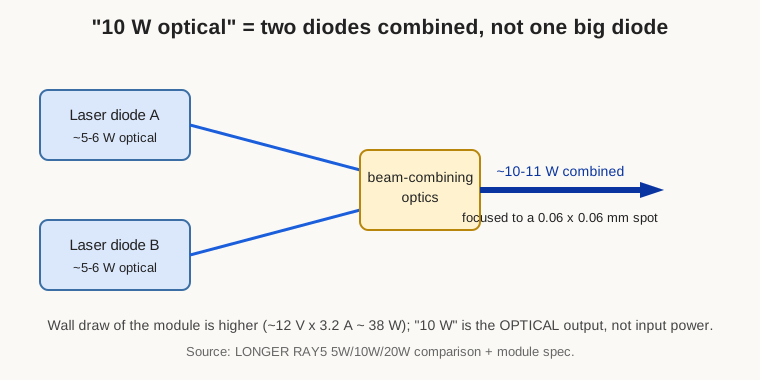
The electrical picture is different and larger. The machine runs from a 12 V, 5 A supply — 60 W of DC available in total — fed from a universal 110 to 240 V AC input. The laser module itself draws roughly 12 V at 3.2 A, on the order of 38 W of electrical input, to produce its ~10 W of light; the rest of the machine’s budget runs the steppers, the controller, the touchscreen, and the module’s cooling fan. The gap between ~38 W in and ~10 W of light out is ordinary diode-laser efficiency; the wasted energy becomes heat, which is why the module has a fan and why it should never be run without one. The practical takeaway for the reader is simple: “10 W” is an honest optical figure, it describes real cutting and marking ability roughly double that of a 5 W single-diode module, and it should never be compared directly against the wall-power wattage some sellers quote for their machines. When comparing lasers, always compare optical watts to optical watts.
There is a family here worth mentioning. LONGER sells the RAY5 chassis with 5 W (single diode), 10 W (two diodes), and 20 W (four diodes) modules, and the modules are interchangeable, so a later upgrade path exists without buying a new machine. The 10 W occupies a sensible middle: meaningfully more capable than the 5 W, with the finest rated spot of the three, without the larger spot and slightly reduced work area that come with the four-diode 20 W head. The number to hold onto is that, roughly speaking, cutting depth scales with optical power: the 10 W will cut about twice as deep per pass as the 5 W, and the 20 W about twice as deep again. Spot size does not track power the same way — more diodes means more emitters to overlap, so the four-diode 20 W actually carries a slightly larger, more rectangular spot than the two-diode 10 W, which is why the 10 W is the connoisseur’s choice for fine detail even though the 20 W wins on brute cutting. For a shop whose heavy cutting is already covered by a CO2 laser, that trade lands squarely in the 10 W’s favour: the diode is here for detail and marking, not for muscling through thick stock, so the finest spot matters more than the deepest cut.
1.5 The Roller — extending a flat machine to round objects
A gantry laser is fundamentally a flat-work machine. Its X and Y axes describe a plane, and everything it engraves is, in effect, a picture painted onto that plane. That is a real limitation the moment a maker wants to put a design around a tumbler, a pint glass, a bottle, or a pen, because the surface of a cylinder is not flat and cannot be held still under a moving head without the design smearing as it curves away from focus.
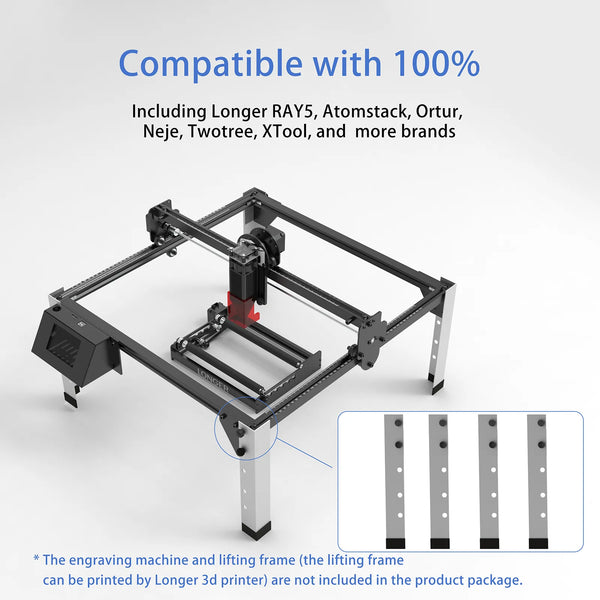
The Roller is LONGER’s answer: a rotary attachment that replaces the machine’s Y axis with a rotating cradle. Physically it is a pair of parallel rubber-tyred rollers on a steel frame, driven by a stepper motor, onto which a cylindrical object is simply laid. The Roller plugs into the same motor connector the Y axis used, so from the controller’s point of view nothing has changed — it still thinks it is commanding a Y motor — but instead of sliding a gantry back and forth, that “Y” motion now rotates the workpiece beneath the stationary-in-Y laser head while the X axis still traverses along the cylinder’s length. Wrap a coordinate system around a cylinder and the machine can engrave the full 360° circumference of a tumbler as easily as it engraves a flat coaster.
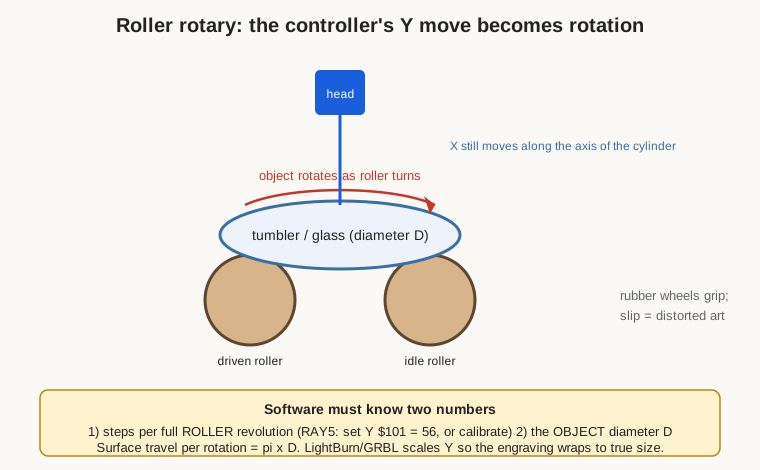
Getting an undistorted result depends on telling the software two things — how far the rollers turn per motor step, and the diameter of the object resting on them — so that a 50 mm-wide logo comes out 50 mm wide on the curved surface rather than stretched or squashed. That calibration, along with mounting technique, avoiding slippage, and coping with tapered glasses, is covered in depth in the third volume. For the purposes of this overview, the important point is that the Roller transforms the RAY5 from a maker of flat plaques and panels into a machine that can personalize drinkware and cylindrical parts — one of the most popular and genuinely useful things a small diode laser can do, and a capability the shop’s big CO2 does not currently have set up.
1.6 Where this leaves the machine
Taken together, the RAY5 10 W is best understood as a precise, affordable, blue-light surface tool with a modest thin-cutting ability and an unusual talent for marking metal, extended by the Roller to round objects. It does not replace the CO2 laser and was never meant to; it fills the gaps the CO2 leaves — fine detail, small quick jobs, anodized and sprayed-metal marking, and cylinders — at a fraction of the cost and complexity. The volumes that follow take the machine apart in turn: the second examines the gantry, the combined-diode module, the 32-bit controller and its touchscreen, and the open-frame safety story; the third covers the software workflow and the Roller in practical detail; and the fourth lays out the full materials map, the laser-safety discipline a Class 4 machine demands, a specifications summary drawn from LONGER’s own figures, and maintenance and further reading.
Comments (0)