Manual Coil Winder · Volume 1
Manual Coil Winder — Overview: the hand-crank winder on the bench
1.1 Why a shop with two CNC winders still wants a hand crank
A coil winding machine does one deceptively simple thing: it turns a bobbin a chosen number of times while wire is laid onto it evenly. The difficulty is in the words chosen number and evenly — a finished coil is only as good as its turn count, the spacing between turns, and the tension the wire was laid under. A machine that automates all three, counting and spacing and ramping under program control, is a wonderful thing to own, and this shop owns two of them. It also owns, and this volume set documents, a machine that automates none of it: a purely hand-cranked winder that leaves every one of those variables in the operator’s hands.
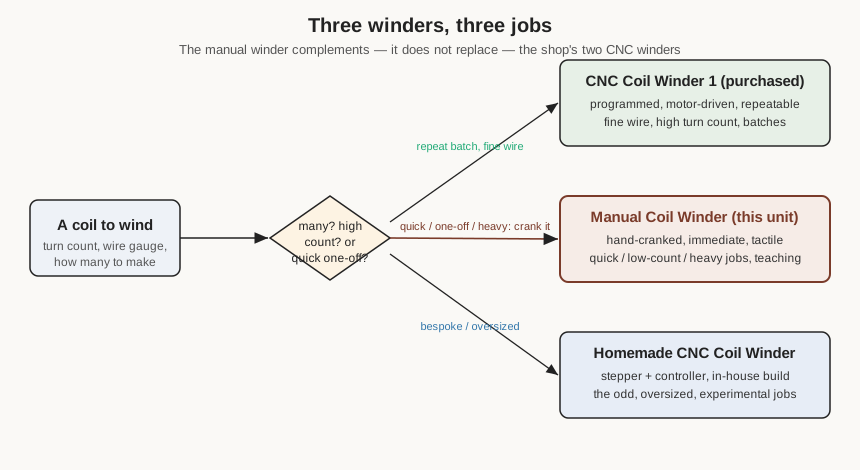
That is not a step backwards. It is a different tool for a different job. The machine documented here is the shop’s manual coil winder — a distinct unit bought through an eBay listing (item 406920548529), sitting alongside a purchased CNC winder (winder 1) and a homemade CNC winder built in-house. Where the two CNC machines are the right choice for a batch of identical coils or a fine-wire winding of many thousands of turns, the manual winder is the right choice for the quick one-off, the low-turn-count coil, the heavy-wire job, and the moment when programming a CNC winder simply is not worth the setup. This volume introduces what the machine is and where it fits; the later volumes cover the mechanism (Volume 2), running a wind by hand (Volume 3), and the specifications, maintenance, and references (Volume 4).
The point of a third winder that has no motor at all is immediacy and control. There is nothing to program, nothing to boot, no parameters to enter — the operator clamps a bobbin, threads the wire, zeroes the counter, and cranks. And because the hand supplies the motion, the operator feels the wire the whole time: the pull of the tension, the pace of the turns, the moment a spool starts to bind. For a low-count coil, a heavy-gauge winding, a repair, or teaching someone how a coil actually goes together, that direct tactile connection is worth more than automation.
1.2 What this machine is
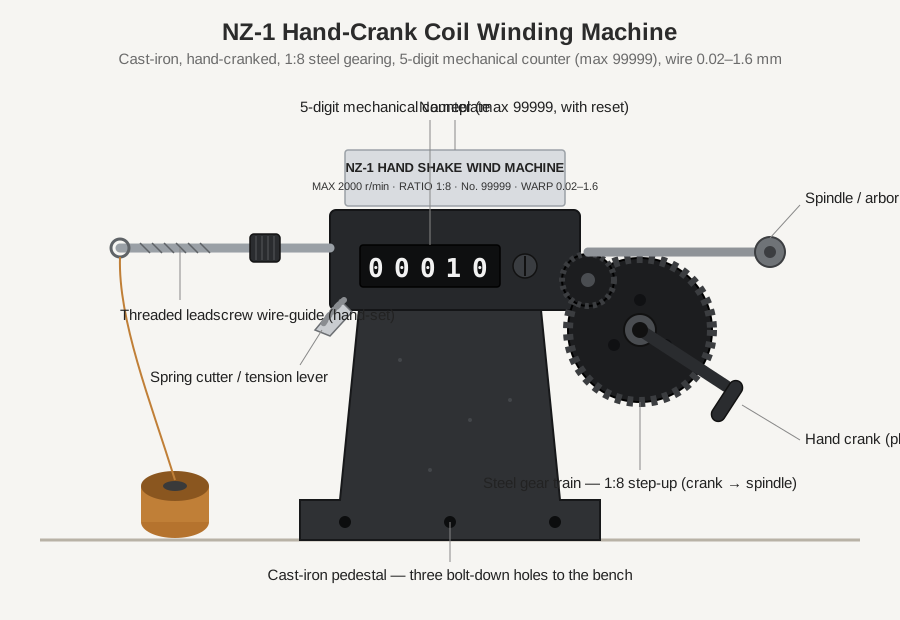
The unit is an NZ-1 “Hand Shake” hand-crank coil winding machine — one of the very common imported hand winders made in China (手摇绕线机), sold under labels such as HEIMAO and Feiyue (飞跃) and built by the Yinzhou Feiyue Electric Tool Factory in Ningbo. The nameplate’s English, printed as “Hand Shake / Electric Wind Thread Machine,” is a mistranslation that has misled more than one buyer: there is no motor in the machine at all. The word to hold onto is hand-crank. A plastic-handled steel crank on the side is the only source of motion, and everything the machine does follows from turning it.
Mechanically the NZ-1 is a compact cast-iron casting that bolts to the bench through three holes in its base and carries a small number of purely mechanical parts:
- A hand crank driving a steel spur-gear train. The gearing is a step-up: on this unit the ratio is 1:8, so one turn of the crank spins the spindle about eight turns. Cranked briskly, the spindle reaches roughly 2000 r/min — fast enough to build a coil at a reasonable rate, entirely under muscle power. (Some NZ-1 variants offer a selectable 1:8 or 1:1 ratio, the 1:1 setting trading speed for slow, heavy, precise work; some Feiyue variants are rated to 3600 r/min.)
- A spindle at the top, carrying a chuck or arbor that grips the bobbin or former, and it is the spindle’s revolutions that get counted.
- A 5-digit mechanical counter — a geared dial reading up to 99999 turns, with a knob to reset it to zero — that the operator watches while cranking.
- A threaded leadscrew wire-guide with a knurled adjuster knob on the left side, which the operator turns to set and advance the wire guide across the width of the bobbin.
- A spring-loaded cutter / tension lever near the counter, for trimming the wire and helping hold the wire path.
The windable wire range on this unit is roughly 0.02 to 1.6 mm (some variants extend to 2.6 mm), and the whole machine is small — about 17.5 cm tall and, with the leadscrew guide extended, about 28 cm wide, on a base of roughly 9 by 8.5 cm. It is a tool that lives on a corner of the bench and is picked up the moment a coil is needed.
None of that makes it a production machine, and none of it is meant to. It has no program memory, no stepper-driven traverse, no brushless spindle, no CNC controller, and no soft-start electronics — because it has no electronics. It is deliberately simple, cheap, and immediate. The counter takes over the one thing a human is genuinely bad at, keeping an exact tally of turns into the thousands, and it leaves everything else — the pace, the tension, the guide, the finishing — to the operator’s hands.
1.3 Where it fits: matching the job to the machine
The value of keeping a manual winder next to two CNC winders comes down to the kind of job in front of the operator. The two CNC machines earn their keep on work that rewards automation: a run of identical coils where a stored program pays for itself over the batch, or a fine-wire winding of many thousands of turns where nobody wants to count by eye or crank by hand for that long. Their programmed traverse and exact electronic turn count are exactly right there.
The manual winder earns its keep on the opposite kind of work. A single coil, wanted now, where setting up and programming a CNC machine would take longer than the wind itself. A low-turn-count coil — a few tens or a few hundred turns — where the counter and the crank get it done before a program could be entered. A heavy-wire job in thick magnet wire, where the operator wants to feel the considerable tension directly and pace the wind by hand rather than trusting a passive brake at speed. A repair or a rework, where a coil has to be unwound and re-wound and the tactile feedback of the crank makes that quick. And teaching — there is no better way to understand what a coil actually is than to wind one by hand, watching the counter climb and feeling the wire lay down turn by turn.
So the division across the bench is not fine-versus-heavy the way it would be between two similar machines; it is automated-versus-immediate. Whenever a job is worth programming or is a fine-wire marathon, it goes on a CNC winder. Whenever a job is quick, one-off, low-count, heavy, or hands-on, the manual winder is faster and more pleasant. The three machines are one capability, not three copies of a tool.
There is also a practical reason a shop ends up with a hand winder: they are cheap, they never break in any meaningful way, and they turn up constantly on the used market. This unit arrived exactly that way — a separate, inexpensive eBay purchase, not a planned match to the CNC winders. A cast-iron hand-crank winder has almost nothing to go wrong: no motor to burn out, no board to fail, no firmware to corrupt. Bought used, the only things to check on receipt are that the counter advances and resets cleanly, that the gears run smoothly, and that the leadscrew guide moves without binding — all covered in the reference volume.
1.4 What a wind actually is (and where the theory lives)
For a reader coming to coil winding fresh, a few terms recur throughout these volumes, and on this machine they map onto physical, hand-driven actions rather than keypad entries.
A turn is one full revolution of the spindle, which lays one loop of wire onto the former; on this machine each turn is registered by the mechanical counter as the spindle goes round. Turns count is simply how many turns the coil needs — the single most important number in any winding, since for a given geometry inductance scales with the square of the turn count. Pitch is the distance the guide advances along the axis per turn; for a close-wound layer the operator advances the guide by about one wire-width per turn so consecutive turns sit shoulder to shoulder. Winding width is the axial span the guide sweeps before the winding starts a new layer stacked on the last. Tension is the steady pull the wire is held under as it is laid — on this machine, supplied and judged entirely by the operator’s hand and a simple friction on the wire path. Taps are intermediate connection points brought out partway through a winding by pausing the crank and leaving a loop or lead.
Those terms — turns, pitch, tension, layers, taps, and the electromagnetic reasoning behind why a coil is wound the way it is — are the subject of two dedicated reference dives elsewhere in the collection, and this machine’s documentation is written to sit alongside them rather than restate them. The “Coils and coil winding” reference dive covers the physics and practice of the coil itself: inductance, turn count, wire-gauge selection, layering, close versus spaced winding, and measuring a finished part. The coming “Transformers and transformer winding” reference dive covers the multi-winding case: primaries and secondaries, turns ratios, interleaving and insulation between windings, taps, and winding order. A reader who wants the why behind a turn count should reach for those dives; these volumes concentrate on the how of this specific hand winder — what its parts do, and how to wind a good coil on it.
One distinction shapes how the machine is used: this is a layer/linear winder, not a toroid winder. It winds onto a former or bobbin held on the spindle, building up cylindrical layers, and it cannot thread wire through the hole of a closed toroidal core — that needs a shuttle winder of a different design. When the shop’s work calls for a toroid it is wound by hand through the core or on dedicated tooling; what this machine handles is the bobbin-and-former case that covers the great majority of transformers, inductors, chokes, solenoids, and pickup-style coils.
That cross-reference runs both ways. The reference dives describe manual and machine winding in the abstract, and this shop’s actual machines — including this hand winder — are the concrete instances they point to. The owner’s-build slots left through these volumes (photographs of the actual NZ-1 on the bench, the real coils it has produced) are the specific examples those more theoretical dives connect back to. Volume 2 now takes the machine apart part by part.
Comments (0)