Manual Coil Winder · Volume 4
Manual Coil Winder — Reference: specifications, maintenance, and links
4.1 Specifications at a glance
The table below collects the specifications of this machine, the NZ-1 “Hand Shake” hand-crank coil winding machine (Chinese 手摇绕线机; commonly branded HEIMAO or Feiyue / 飞跃, made by the Yinzhou Feiyue Electric Tool Factory, Ningbo), of which the eBay unit (item 406920548529) is the shop’s example. The values here are taken from the unit’s nameplate and confirmed on the owner’s machine; where a figure varies across NZ-1 and Feiyue variants, both the unit’s value and the variant range are noted. The nameplate’s English — “Hand Shake / Electric Wind Thread Machine” — is a mistranslation: there is no motor.
Table 1 — Specifications at a glance
| Parameter | This unit (NZ-1) | Notes |
|---|---|---|
| Drive | Hand crank → steel spur-gear train | No motor of any kind |
| Speed rate (gear ratio) | 1:8 (step-up: ~8 spindle turns per crank turn) | Some variants selectable 1:8 or 1:1 |
| Max spindle speed | ~2000 r/min (cranked briskly) | Some Feiyue variants rated ~3600 r/min |
| Turn counter | Mechanical 5-digit dial, max 99999, with reset | Nameplate “MAXIMUM NO. 99999” |
| Windable wire diameter (“warp” / 线径) | 0.02–1.6 mm | Some variants 0.02–2.6 mm |
| Wire guide / traverse | Threaded leadscrew shaft, hand-set by knurled knob | Operator advances the guide; not motor-driven |
| Cutter / tension | Spring-loaded cutter / tension lever near the counter | — |
| Frame | Cast iron, three bolt-down installation holes | Fix firmly to the workbench |
| Height | ~17.5 cm (6.88 in) | — |
| Width | ~28 cm (11 in) with leadscrew guide extended | — |
| Base | ~9 × 8.5 cm (3.54 × 3.34 in) | Compact benchtop, easy storage |
| Power | None | Purely muscle-powered |
| Program memory | None | Every wind is set up by hand each time |
| eBay item | 406920548529 | The shop’s purchased unit |
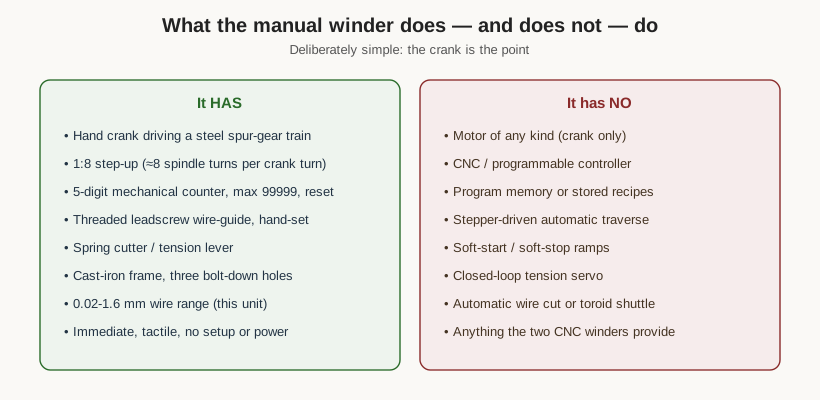
The most useful thing to keep with the machine is not a manual — a hand winder this simple barely needs one — but a note of the owner’s confirmed values above and the arbor sizes that fit the shop’s common bobbins. Everything about operating the machine is visible in the machine itself.
4.2 Where this machine sits in the shop
The NZ-1’s role is defined not by a wire band but by the kind of job. Its 0.02–1.6 mm wire range spans most of the practically useful magnet-wire sizes, but the reason to reach for it is speed and directness, not a particular gauge. As covered in Volume 1, the shop runs three winders as one capability: the purchased CNC Coil Winder 1 and the Homemade CNC Coil Winder take the work that rewards automation — batches of identical coils, fine-wire windings of many thousands of turns, anything worth programming — while this manual winder takes the quick one-off, the low-turn-count coil, the heavy-wire winding, the repair, the teaching example, and the moment a coil is simply wanted now with nothing to set up.
4.3 Maintenance
A cast-iron hand-crank winder is about the lowest-maintenance machine on the bench — there is no motor, no electronics, and nothing to wear out quickly. Keeping it accurate is a matter of a little cleanliness and a few drops of oil.
Oil the counter and gear train lightly. The steel spur-gear train and the geared counter run more smoothly and last longer with a light machine oil on the gear teeth and the counter mechanism. A drop where the crank shaft enters the frame, and on the counter’s drive, keeps the action light and the count reliable. Wipe off old, grit-laden oil rather than piling fresh on top of it.
Keep the crank and spindle bearings clean and free. The crank should turn smoothly with no grinding, and the spindle should run true and quiet. Keep swarf, enamel dust, and stray wire whiskers out of the bearings and off the gear teeth; a stiff or notchy crank usually means dirt or dried oil in the works.
Keep the leadscrew guide moving freely. The threaded guide shaft and its knurled knob should move the wire guide smoothly along its length. A light oil keeps it free; grit on the leadscrew makes the guide advance unevenly, which shows up as uneven turn spacing. Clean it before re-oiling.
Look after the tension path and cutter lever. Whatever the wire runs over — a felt pad, a post, or the spring cutter/tension lever — wears a groove over time, and a grooved or nicked surface scores enamel and sheds insulation into the winding. Inspect the surfaces the wire touches and dress or replace worn felt; check that the spring cutter/tension lever returns cleanly.
Keep it bolted down. The three-hole cast-iron base is meant to be fixed to the bench; check the bolts stay tight, since a hand winder that rocks makes truing and even winding harder. There are no electrical safety items to service — the machine has no power at all — which is one of the quiet virtues of a purely mechanical tool.
4.4 Troubleshooting
Almost every problem on a machine this simple is mechanical and obvious, because there is nothing hidden between the crank and the coil.
The turn count does not match the coil. On a hand winder this is either a forgotten reset (the counter was not zeroed before the wind) or slip — the bobbin creeping on its arbor or the arbor on the spindle. The counter faithfully tallies spindle revolutions, so a mismatch between the dial and the actual turns is a grip problem or a zeroing mistake. Re-seat and re-clamp the bobbin, check the arbor fit, and remember to reset the dial before each wind.
Turns pile up or leave gaps instead of lying flat. On this machine that is guide technique, not a parameter: the operator advanced the leadscrew guide too slowly (turns crowd and climb) or too fast (gaps open). Match the guide advance to the wire’s overall diameter for a close wind, keep the crank pace steady, and reverse cleanly at the flanges. If the pitch is right but turns still wander, tension is too low or the bobbin is running out.
The wire breaks or stretches. Too much hand tension, a nicked guide or a grooved tension surface scoring the wire, or a spool that binds and jerks. Ease the tension, inspect and dress the surfaces the wire runs over, and confirm the spool pays off freely. Fine wire is unforgiving here — but because the wind is hand-paced, a break usually stops the wind the instant it happens.
The crank is stiff, notchy, or noisy. Dried oil, dirt, or swarf in the gear train or bearings. Clean the gear teeth and the crank shaft, remove any trapped debris, and re-oil lightly. A gear train that has never been oiled runs harsher than it should.
The guide advances unevenly. Grit or dried oil on the leadscrew, or a bent guide. Clean and lightly oil the leadscrew, check the guide rides smoothly along its full travel, and confirm the knurled knob turns without binding.
4.5 Accessories and consumables
A working hand winder needs a little standing kit: a set of arbors and mandrels sized to the shop’s common bobbin bores; felt pads or spare tension material for the wire path; start posts, tape, and sleeving for anchoring and dressing leads; interlayer insulation (polyester film, tape, or paper) for layered and multi-section windings; and a stock of enamelled magnet wire in the shop’s usual gauges. On the measurement side, an LCR meter for inductance, a milliohm-capable meter for winding resistance, a micrometer for verifying wire diameter, and a small spring scale (useful for learning what a given hand tension actually is in grams) turn a wound part into a verified part. A pair of thin gloves or finger cots makes holding fine wire under tension more comfortable and more consistent.
4.6 Buying and receiving a used hand winder
Because this unit came used through eBay, a few checks at receiving are worth recording — though a cast-iron hand winder has almost nothing to go wrong. Confirm the counter advances one per spindle revolution and resets cleanly to 00000; crank the machine and watch the dial. Check the crank and spindle turn smoothly with no grinding, and that the gear train is quiet and free. Confirm the leadscrew guide moves along its length without binding and that the knurled knob turns freely. Verify the spring cutter/tension lever returns under its spring. Make sure the three base holes are intact for bolting down. There is no voltage to check, no firmware, and no motor to test — the machine is either mechanically sound or not, and it is easy to tell at a glance.
4.7 Cross-links to the reference dives
This machine’s documentation is written to sit alongside two dedicated reference dives on research.fubsypoly.com/electrical-components, which carry the theory and practice this volume set deliberately does not repeat:
- Coils and coil winding — the physics and practice of the single coil: inductance and how turn count sets it, wire-gauge selection, layering and close-versus-spaced winding, self-capacitance, and measuring a finished coil. Reach for this dive for the derivation behind any turn count wound on this machine, and for how to interpret the inductance and resistance readings taken to verify a wind (Volume 3).
- Transformers and transformer winding (coming) — the multi-winding case: primaries and secondaries, turns ratios, interleaving and insulation between windings, taps, and winding-order conventions. Reach for this dive when the job on the machine is a transformer, when a wind is broken into sections and taps, and for what interlayer or interwinding insulation to add during the pauses in a hand wind.
Within the broader Model Shop collection, the winder connects outward to the projects that consume its output: the coils and transformers wound here feed the shop’s electronics builds, restorations, and instrument work, and the same measurement habits (resistance, inductance, turns ratio) recur wherever a wound part has to meet a spec. Within the Model Shop collection this machine sits beside its two companions, CNC Coil Winder 1 (the shop’s purchased programmable winder) and the Homemade CNC Coil Winder (the in-house CNC build for the outlier jobs), and is best read as the immediate, hand-driven member of that three-machine winding capability — the one reached for when a coil is wanted quickly, in low count, in heavy wire, or by hand.
4.8 Sources and further reading
- NZ-1 “Hand Shake” hand-crank coil winding machine (手摇绕线机) — nameplate and product listings; HEIMAO / Feiyue (飞跃) branding, Yinzhou Feiyue Electric Tool Factory, Ningbo. The specification basis for this machine: 1:8 ratio, ~2000 r/min, 5-digit counter to 99999, 0.02–1.6 mm wire, cast-iron three-hole base.
- eBay listing 406920548529 — the specific unit purchased.
- Coil-winding tension and wire-guide practice references for setting hand tension by wire gauge and laying even layers.
- Model Shop’s Coils and coil winding and coming Transformers and transformer winding reference dives for the underlying theory and measurement practice.
Comments (0)