Manual Coil Winder · Volume 2
Manual Coil Winder — The machine in detail: crank, gears, counter, guide
2.1 A purely mechanical machine
Everything the NZ-1 does resolves into a handful of mechanical parts, and there is not a single electrical component among them. A hand crank drives a steel spur-gear train that spins a spindle; the spindle carries the bobbin and turns a mechanical counter that tallies revolutions; a threaded leadscrew guide lays the wire across the bobbin width; a friction on the wire path, helped by a spring cutter/tension lever, keeps the wire taut; and the whole thing is a cast-iron frame bolted to the bench. Understanding the machine means understanding those parts and, above all, understanding that the operator — not any controller — supplies the precision. The machine counts and gears; the hand does everything else.
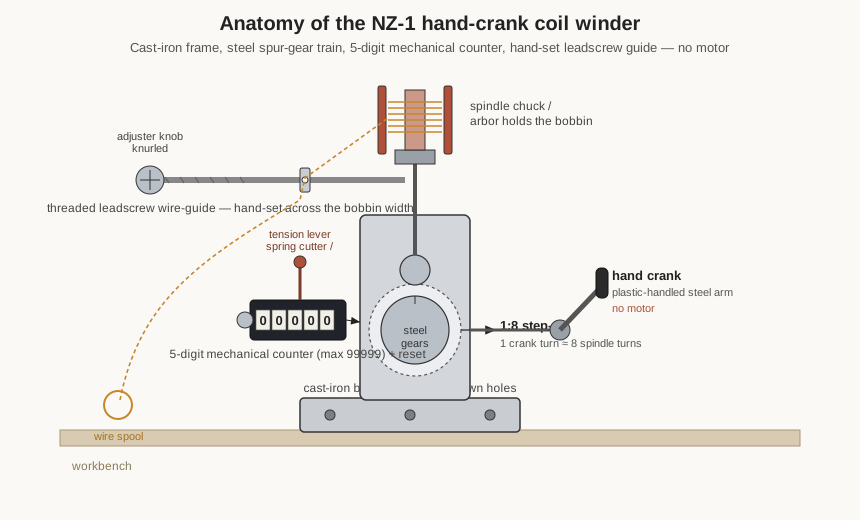
Each part follows in turn, using the confirmed values from my unit’s nameplate and my machine. Because everything is mechanical, “understanding the machine” and “understanding how to run it” are almost the same thing — there is no hidden control logic between the crank and the coil.
2.2 The crank and the gear train
The only source of motion is the hand crank — a plastic-handled steel arm on the side of the frame. Turning it drives a steel spur-gear train inside the casting, and that gearing is a step-up: on this unit the ratio is 1:8, meaning one turn of the crank produces about eight turns of the spindle. That multiplication is what makes a hand winder practical. Without it, a 600-turn coil would take 600 pulls of the crank; with the 1:8 gearing it takes about 75. Cranked at a comfortable, brisk pace, the spindle reaches roughly 2000 r/min — enough to build a coil quickly while the operator still has full control of the pace.
Some NZ-1 variants are built with a selectable ratio, offering 1:1 alongside the 1:8. The 1:1 setting gives up the speed multiplication in exchange for slow, deliberate, one-turn-per-crank control, which is what a heavy-wire winding or a very-low-count precision job sometimes wants; the operator trades throughput for feel. Certain Feiyue-branded variants of the same basic machine are rated to a higher top speed, around 3600 r/min. The values that matter here are this unit’s: 1:8, and about 2000 r/min at the spindle when cranked hard.
Because the drive is a plain gear train, the relationship between crank and spindle is rigid and immediate. There is no clutch, no slip, no ramp — start cranking and the spindle turns at once, stop and it stops (the coil’s own small inertia aside). That directness is exactly what gives the operator control: the pace of the wind is the pace of the hand, moment to moment, with nothing between them.
2.3 The spindle, chuck, and the mechanical counter
The spindle is the driven shaft the coil is built on. It carries a chuck or a threaded arbor that grips the bobbin or former — trapping the bobbin’s flanges against a shoulder so it cannot slip or wobble — and for odd formers the shop makes or buys an arbor to suit the bore. Getting the former running true on the arbor is the single most important setup step: a bobbin that runs out (wobbles) varies the wire tension once per revolution and can walk the winding off its intended lay.
What the spindle turns, besides the coil, is the 5-digit mechanical counter. This is a geared dial — driven off the spindle so that it advances one increment per spindle revolution — reading up to 99999 turns, with a knob to reset it to 00000 before a wind. It is the machine’s one concession to the fact that humans cannot count to several thousand while doing anything else. The operator’s job during a wind is largely to watch this dial: it climbs as the crank turns, and the wind stops when it reaches the target. Because it is purely mechanical and geared directly to the spindle, it cannot drift or lose count electronically — but by the same token it faithfully counts spindle revolutions, so if the bobbin were ever to slip on its arbor the dial would read more turns than the coil actually received. Grip and truth on the arbor are what keep the count honest.
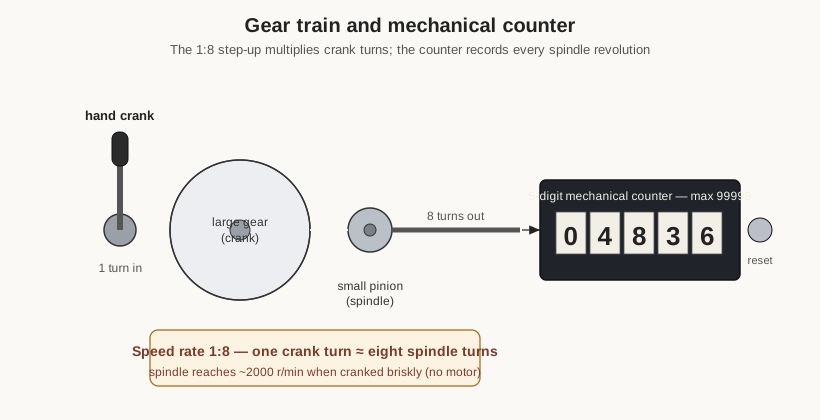
The counter’s five digits — a full 99999-turn range — matter more than they might seem. Fine-wire coils can run to tens of thousands of turns, and a counter that rolled over at 9999 would force the operator to track thousands separately. The five-digit dial covers essentially any coil this machine will ever wind in a single count.
2.4 The leadscrew wire-guide
The wire-guide is the part that lays each turn beside the last, and on the NZ-1 it is a threaded leadscrew shaft with a knurled adjuster knob on the left side of the machine. The guide carries the wire and rides along the leadscrew; turning the knob moves the guide along the bobbin’s axis. This is the crucial difference from a CNC winder: the traverse is not driven automatically in lockstep with the spindle. There is no stepper motor stepping the guide by one wire-diameter per turn. Instead, the operator advances the guide by hand, turning the knob to walk the wire across the width of the bobbin as the turns build up.
That means the pitch — the spacing between turns — is set by the operator’s hand, not by a parameter. To make a close-wound layer, the operator advances the guide by roughly one wire-width for every turn (or a fraction of a knob-turn per crank, judged by watching the wire lay down); to make a spaced winding, the guide is advanced faster so gaps open between the turns. When the wire reaches the edge of the intended winding width, the operator reverses the knob to start the next layer back across the former. The leadscrew makes this smooth and repeatable-by-feel — it moves the guide steadily and holds its position — but it is the operator who decides how far and how fast the guide moves. On a small, low-count coil the guide is sometimes even nudged directly by hand; the leadscrew and knob are there to make longer, neater windings controllable.
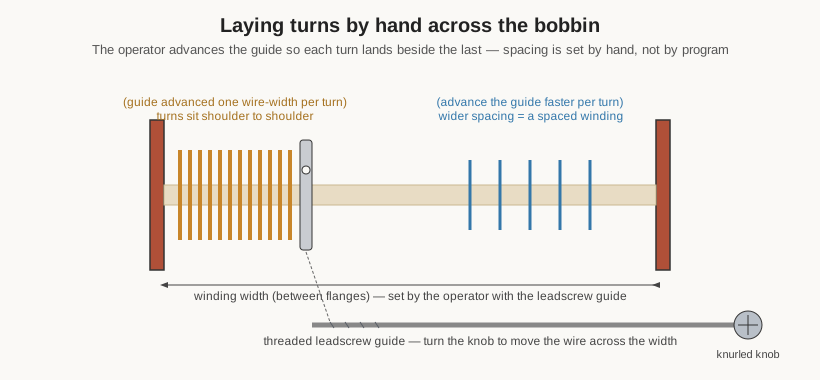
This is where the manual winder asks the most of the operator and gives the most direct control. A CNC winder guarantees a perfectly even traverse and takes that judgement away; the hand winder puts it back, which is a burden on a long fine-wire layer and a genuine advantage on a heavy-wire or oddly-shaped winding where a human eye and hand adjust to the work as it grows.
2.5 Tension: supplied by the operator
Tension is the quiet variable that decides whether a winding is any good. Too little and the turns are loose, the coil is bulky and rings, and the wire wanders off its intended pitch; too much and fine wire stretches (changing its resistance and, past a point, its diameter) or simply snaps. On this machine there is no tension servo and no calibrated brake — tension is supplied and judged by the operator’s hand on the wire path, aided by a simple friction where the wire runs and by the spring-loaded cutter/tension lever near the counter, which sits in the wire path and helps hold and trim the wire.
That the operator owns the tension is the whole character of a manual winder. The hand feels the pull directly and adjusts it continuously — easing off on fine wire, bearing down on heavy wire — in a way no passive brake can. Many operators run the wire lightly through their gloved fingers, or over a felt pad or a simple post, to add steady drag, and set the amount by feel and by watching how the first layer packs. Snug, evenly packed turns are right; loose, wandering turns mean more tension; wire that stretches or squeaks means less. Because the wind is paced by hand, tension and speed are naturally managed together: on heavy wire or a delicate former the operator simply cranks slower and holds the wire more firmly, all in one continuous act of control.
2.6 The frame, the base, and the size of the thing
The whole machine is a compact cast-iron casting. The mass and stiffness of cast iron matter for a hand tool: they keep the machine from walking or flexing while it is cranked, and they give the spindle bearings a solid seat. The base has three bolt-down holes so the machine can be fixed firmly to the workbench — essential, since a hand winder pushed and pulled by the crank would skate around an unsecured bench. Bolted down, it becomes effectively part of the bench and can be cranked with both the wind and the guide under full control.
The NZ-1 is small: about 17.5 cm tall (6.88 in) and, with the leadscrew guide extended, about 28 cm wide (11 in), on a base of roughly 9 by 8.5 cm (3.54 by 3.34 in). It stores easily and takes up a corner of the bench rather than a footprint of its own. That compactness is part of why a shop keeps one even alongside larger CNC winders — it is always to hand, and it is never in the way.
2.7 How this machine complements the two CNC winders
The manual winder shares nothing mechanically with the shop’s CNC winders — no controller, no motor, no automatic traverse — and that is precisely the point. The two CNC machines (the purchased winder 1 and the homemade CNC winder) provide programmed, motor-driven, repeatable winding with an exact electronic count and an automatic traverse; the manual winder provides immediate, hand-paced, tactile winding with a mechanical count and a hand-set guide. An operator does not “move between them” the way one would between two similar CNC winders; rather, the manual winder is reached for when the job does not want automation at all — the quick one-off, the low-count coil, the heavy-wire winding, the teaching example, or the backup when the shop simply wants a coil now with nothing to set up.
The specific arbor set, the exact gear teeth, and any wear or modification on the owner’s unit are properties of the physical machine, best read from it directly; the confirmed nameplate values — hand-crank drive, 1:8 ratio, ~2000 r/min, 5-digit counter to 99999, 0.02–1.6 mm wire, cast-iron three-hole base — are used as fact throughout these volumes. Volume 3 turns from the parts to the procedure: how to actually wind a coil by hand on this machine.
Comments (0)